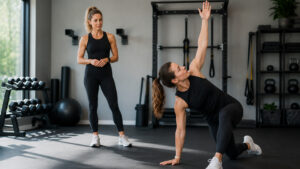



I had a client who never complained of pain during split squats. I watched her perform three repetitions before I changed the exercise. On one side, her knee drifted inward. On the other, her balance disappeared halfway through the movement. Her strength looked symmetrical on bilateral lifts. Her movement did not.
That moment is why a single-leg training assessment now sits at the center of how many experienced coaches program lower body work. Single-leg work is not simply another way to challenge the legs. It is one of the clearest windows into how clients actually move. If you coach long enough, you will see it too. The exercise stops being an accessory. It becomes the assessment, and what you do with the information changes everything that comes after it.
The Single-Leg Assessment Framework
Traditional movement screens give you a snapshot. They identify mobility restrictions, movement limitations, and training history before a program begins. Single-leg training extends that snapshot into every session.
Every split squat, reverse lunge, step-up, and single-leg Romanian deadlift gives you a chance to observe balance, joint control, stability, coordination, and confidence under load. Those observations reveal information that bilateral exercises cannot.
A barbell squat lets stronger muscles cover for weaker ones. A leg press removes most of the balance demand. Single-leg exercises strip out those compensations and make movement quality visible.
Instead of asking whether the client finished the set, ask a different question: what is this movement telling me?
“The first time a client hits a unilateral pattern, they show you more than their strength—they show you how their body has chosen to solve problems. Your job isn’t to fix every compensation on rep one; it’s to listen long enough that your programming actually answers what their movement is saying.”
— Jonathan Mike, PhD, CSCS*D, NSCA-CPT*D, USAW, NKT-3
The Compensation Clues That Change Programming
Many coaches are trained to correct movement the moment something looks off. Experience teaches you to watch a little longer.
A client who consistently shifts weight to one side may not lack strength. She may be guarding a previous injury. Another client has adequate strength but poor proprioception. A third simply needs more exposure to single-leg loading before the pattern becomes efficient. Different problems require different coaching strategies.
A cue that works: “Let’s slow this rep down. I’m less interested in how many you can do than how well you control each one.” That adjustment tells you more than adding another twenty pounds to the bar.
Here is the tradeoff. Movement-first coaching slows visible progression in the short term. Clients spend longer refining positions before they chase heavier loads, and some of them will notice. Across a full training year, that investment produces cleaner movement, more confidence, and fewer recurring compensation patterns.
Unilateral Training Should Influence Every Program
The assessment only matters if it changes decisions. A client who consistently loses pelvic control during split squats has just handed you a sequencing decision, a loading decision, a stability progression, and a tempo decision.
A client with excellent balance who struggles with frontal-plane control during lateral lunges hands you a different one. That information shifts accessory selection and warm-up priorities.
Strong unilateral training coaching does not treat single-leg work as a corrective phase that eventually disappears. It becomes a recurring checkpoint across the entire training relationship.
As clients get stronger, older, busier, or return from injury, the same movements keep producing information. The assessment never really ends.
“Every time a single-leg pattern forces an athlete to fight for balance or control, it hands you a programming decision. The strongest coaches don’t ignore those clues; they pivot the plan in real time so the session stops being a workout and becomes a strategy meeting with the athlete’s movement.”
— Jonathan Mike, PhD, CSCS*D, NSCA-CPT*D, USAW, NKT-3
The Difference Between Exercise Selection and Coaching
The biggest shift here is not biomechanical. It is philosophical. Coaches who treat unilateral exercises as accessories ask whether clients completed them. Coaches who treat them as assessments ask what they learned. It is a small change, and it influences every programming decision that follows.
It changes when exercises progress. It changes how you communicate. It changes what you prioritize. It changes how individualized your coaching becomes.
“The day unilateral work stops being ‘extra leg stuff’ and becomes one of your primary assessment tools is the day your coaching stops chasing volume and starts chasing understanding. Once you’ve seen how much information lives inside a single split squat, it’s almost impossible to go back to just checking the box that the exercise was completed.”
— Jonathan Mike, PhD, CSCS*D, NSCA-CPT*D, USAW, NKT-3
What Changes When Coaches Adopt This Mindset
Single-leg exercises do not replace bilateral strength training. They make bilateral strength training smarter.
By observing unilateral movement quality every session, you gain ongoing insight into balance, stability, coordination, confidence, and control without scheduling separate assessment days. The result is better-informed programming and more individualized coaching.
Clients may never know why certain exercises stay in their programs. That is fine. You know exactly why they are there. Every repetition is another chance to observe, and every observation is another chance to coach.
Related: Coaching in 2030: Skills Fitness Coaches Need to Build Right Now
FitHire — Browse Performance and Movement Coaching Roles
Coaches who can read movement and adjust in real time are exactly who performance facilities and studios are hiring for senior and specialist roles. FitHire by Coach360 connects coaches with employers looking for that skill set.
Browse performance and movement coaching roles at fithirebycoach360.com
FAQ
Why is single-leg training considered an assessment?
Single-leg training reveals balance, stability, coordination, and movement compensations that bilateral exercises conceal. Coaches use those observations to individualize programming throughout the client relationship rather than relying on one intake screen.
Should unilateral training replace bilateral strength exercises?
No. Bilateral lifts remain essential for building strength and power. Unilateral training complements them by producing ongoing movement information that sharpens programming decisions.
Which single-leg exercises provide the best assessment information?
Split squats, reverse lunges, step-ups, lateral lunges, and single-leg Romanian deadlifts each reveal a different aspect of movement quality. The best choice depends on the client’s goals, experience, and current ability.
How often should coaches reassess unilateral movement?
Every session is an opportunity to observe. Rather than treating assessment as a one-time event, experienced coaches use unilateral exercises throughout the training process to monitor control, balance, and movement quality.
About Erin Nitschke
Dr. Erin Nitschke, NSCA-CPT, NFPT-CPT, ACE Health Coach, ACE-CPT, Fitness Nutrition Specialist, Therapeutic Exercise Specialist, Pn1, FNMS, and DSWI Master Health Coach, is a seasoned college professor in health and human performance. She is a nationally recognized presenter, industry writer for IDEA, NFPT, Fitness Education Online, and Youate.com, and an active member of the ACE Scientific Advisory Panel. With extensive experience in health and exercise science, Erin specializes in holistic, evidence-based approaches to wellness. Her passion lies in empowering individuals to lead healthier, more vibrant lives through personalized coaching. Erin’s philosophy centers on education, accountability, and sustainable behavior change—guiding clients to achieve long-term success in nutrition, fitness, stress management, and overall well-being. To connect with Dr. Nitschke, email her at erinmd03@gmail.com or on Instagram: @nitschkeerin