


How to specialize as a fitness coach is usually described as one decision, and the coaches who make it work are often making two. Hilario Amezcua, who goes by Lalo, narrowed his practice to posing and moved it entirely online in the same stretch of 2025, and either move without the other would have produced a much smaller business.
Before that, roughly 75 percent of his work was fitness training and competition prep, with posing making up the remaining quarter. He gave up the larger share. Within four weeks of fully transitioning, his income had tripled.
Two Decisions, Not One
Narrowing alone would have capped him at whatever posing demand existed in the Houston area, which is a ceiling he could see. Going online alone would have meant doing competition prep remotely, which was precisely the work he wanted out of. Together, the two moves removed the ceiling and the drain at the same time.
The part he wanted out of was not the coaching. It was everything attached to prep.
“Competition prep involves much more than training and nutrition,” Amezcua says. “You become involved in people’s personal lives, their struggles, their relationships, and sometimes situations involving trust, hormones, and decisions outside your control. Over time, I realized I didn’t like who I was becoming.”
Knowing that did not make the decision easy, and he is direct that fear held him in place. He had spent years building a consistent income and wasn’t sure he could replace it.
The thing that finally moved him was his son, who is autistic. Amezcua spent a full summer coaching while having his son with him, taking breaks between sessions to go somewhere or play a game before returning to work. That summer showed him he did not have to choose between building the business and being present.
Armour Posing officially launched in early 2025, with the transition to exclusively online coaching finished that July.
The Specialty Was a Gap, Not a Topic
Most advice about how to specialize as a fitness coach says to pick a topic you like. Amezcua found something more durable: something the market was already paying for and doing badly.
He discovered it by sitting in. As he took on more competitors, he hired posing coaches and attended sessions to watch. “What I started noticing was that just because someone knew how to pose didn’t necessarily mean they knew how to teach someone else to pose.”
He had the background to notice it. Amezcua started salsa dancing in 1998 and was competing within about two years, which gave him body awareness, coordination, and presentation before he ever entered the fitness industry in 2007. In those sessions, he realized he could break a movement down and explain it in a way an athlete could actually use.
“Knowing the quarter turns is one thing. Being able to coach them means understanding the individual athlete’s abilities and knowing how to adapt the technique to that person.”
— Lalo Amezcua, founder, Armour Posing
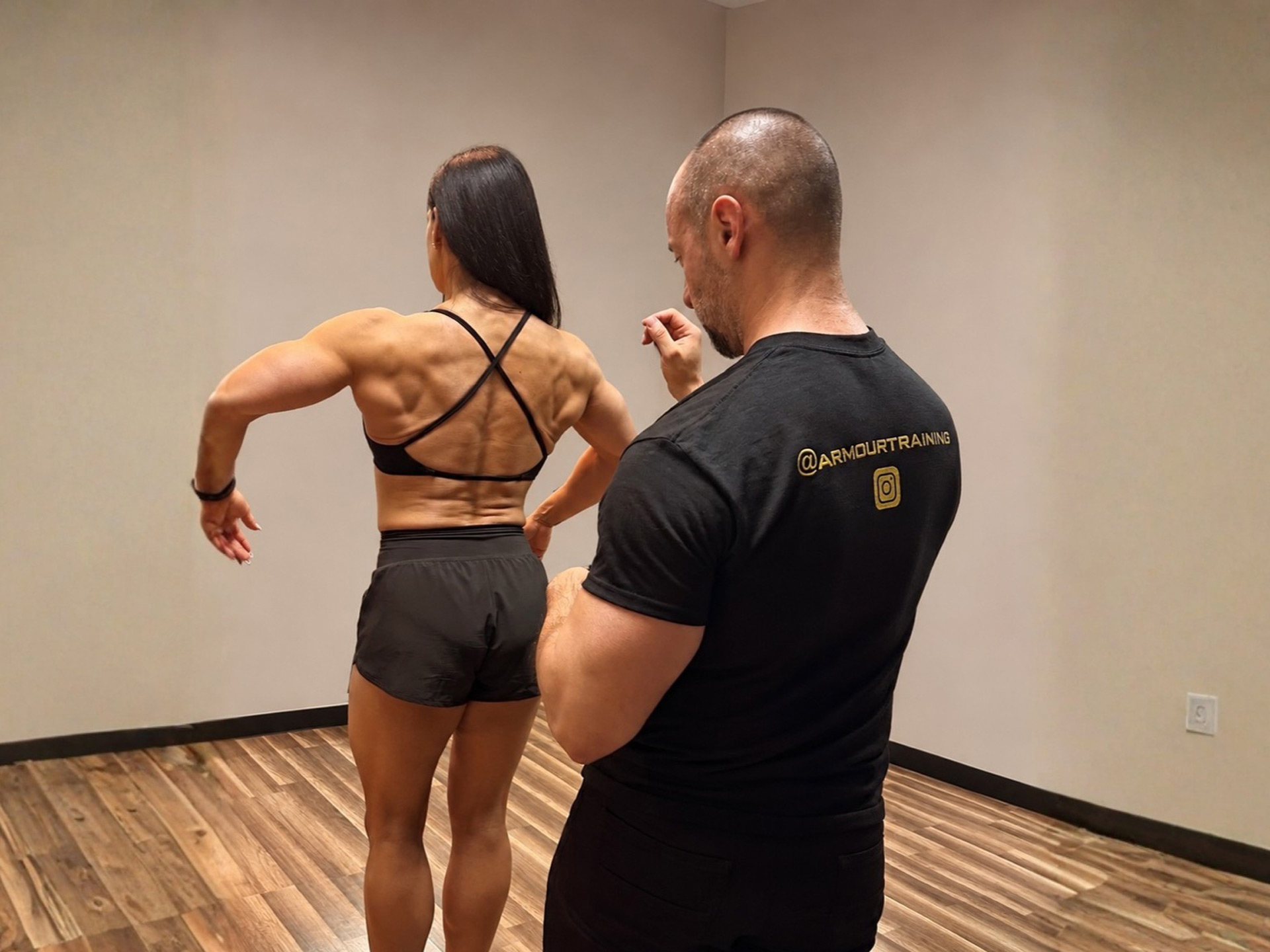
In practice, that means assessing whether an athlete can hold stability in heels, how their balance is, how much mobility they have, and then changing foot placement or rotation to reach the same presentation without forcing a position they cannot control.
The work itself is more physically specific than it sounds. He coaches through FaceTime and WhatsApp using mirror-image teaching, reversing his own movements so athletes can follow him through a screen. For roughly 14 hours of his day, his left is his right.
Not every athlete wants to learn that way. Armour Posing keeps a directory of coaches who work in person, which is useful in two directions. You can ask to be listed if the room is where you do your best work, and you have somewhere to send an athlete who needs hands-on sessions if it isn’t.
What Makes the Revenue Survive a Season
Competition runs on a show calendar, which should make a posing business lurch between feast and famine. Three things in how Amezcua structured it keep that from happening, and all three transfer to other seasonal specialties.
- Sell into the off-season. Athletes commonly delay posing work until weeks before a show, and he pushes them earlier, when there is time to build muscle memory and confidence without competition pressure.
- Use geography. Going remote made it possible: competition seasons differ by country and organization, so one region’s off-season overlaps with another’s show season, spreading demand across months that would otherwise be quiet.
- Read revenue and schedule together. Clients book weeks or months ahead, so revenue lands when a package is purchased while the sessions happen later. A thin revenue month does not mean a thin schedule.
“We still have busier and slower periods financially,” he says, “but I look at both revenue and the upcoming schedule rather than assuming one tells the whole story.”
His calendar has run about six weeks out during stretches. He also tracks repeat business rather than new-client volume, with athletes booking through a prep and continuing into the off-season, some weekly for months.
What It Costs
Amezcua is clear that this structure is not for everyone, and his caution is specific rather than general.
“The biggest downside is that you’re putting your livelihood into one specialty. When you narrow your focus, you’re depending on demand for that one thing.”
Two groups in particular should not attempt it. A coach treating it as a side income cannot deliver the consistency the work requires. A coach still actively competing will hit their own travel and prep against client deadlines, producing the cancellations and reschedules that erode trust fastest.
“Athletes preparing for a competition have deadlines,” he says. “They need to know their coach will be available, especially as their show approaches.”
He names a second cost without flinching: the business only works if you are willing to be seen.
“You can be an incredible coach, but if you’re not putting yourself out there, you’re limiting how far your business can grow.”
— Lalo Amezcua
Most of his clients found him through social media, and his videos began reaching international audiences in early 2025. That reach is what turned a Houston specialty into a business serving athletes across divisions, organizations, and countries. It also required getting comfortable in front of a camera, which is a tax a lot of excellent coaches would rather not pay.
The question his path actually poses to an established coach is narrower than whether to specialize. It is whether there is a part of the work you would keep doing for free, and whether anyone around you is doing it badly.
Related: Why Fitness Coaches Get Bored (And How to Fix It Without Ruining Your Clients’ Results)
FitHire: Find Clubs That Value a Specialist
The facilities worth working for hire for depth rather than coverage. FitHire by Coach360 connects health, fitness, and wellness coaches with the clubs, studios, and brands hiring now.
Frequently Asked Questions
Does specializing as a fitness coach reduce your income?
Not necessarily, and it can do the opposite. Amezcua gave up roughly 75 percent of his revenue base when he dropped training and competition prep, and his income tripled within four weeks of transitioning fully to posing. The outcome depends on whether the specialty has demand beyond a local market, which is why narrowing and moving online worked better together than either would have alone.
How do you handle seasonal revenue in a coaching business?
Three levers help. Selling into the off-season extends the buying window beyond the weeks before an event. Working across regions or countries spreads demand, since seasons rarely align. And reading the forward schedule alongside revenue prevents a slow billing month from reading as a slow business, because clients who book packages months ahead pay before the sessions happen.
What makes a good niche to specialize in as a fitness coach?
A gap rather than a preference. Amezcua identified posing after watching coaches he had hired for his own athletes and noticing that knowing how to pose did not mean knowing how to teach it. A specialty is most defensible where demand already exists and the available service is weak, which is a different question from what a coach most enjoys.
Where can I find an in-person posing coach?
Armour Posing maintains a directory of coaches who work in person. A coach who prefers in-person sessions can request a listing, and a coach who works over video can use it to refer an athlete who wants hands-on coaching.
About Jessica H. Maurer
Jessica is a recognized fitness business consultant and strategist focusing on transforming businesses from overwhelmed to organized. Her international presentations, workshops, certifications, and consultations underscore her commitment to helping fitness professionals and businesses realize their full potential. When Jessica takes the stage, she’s sharing fresh ideas and inspiration that spark positive change. Jessica’s international presentations and consultations are about growth, career transformation, overall wellness, and making fitness a joyful journey. Her expertise spans education, program and instructor development, and brand evolution, making her a key player in elevating the industry. Jessica also played a pivotal role in developing the Mental Well-being Association’s certification for Fitness Professionals., always striving to bring a holistic approach to wellness that’s as uplifting as it is effective.
Jessica has presented at prestigious events like IDEA World, Fitnessfest ACSM Health & Fitness Summit, SCW Mania, AsiaFit, and more. She has worked with brands such as FIT4MOM, SFR, BOSU, Lebert Fitness, Savvier Fitness, SCW Fitness, FitSteps, canfitpro, IDEA, and VIBES music. She also has written content for the IDEA Fitness Journal, canfitpro Magazine, Mental Well-being Association, FIT4MOM, Motherly, and more.