
Inside Ultimate Longevity Center’s Franchise Model With President Don Michael
Every so often something genuinely good stops being a luxury.
That is the bet Don Michael is making. The president of Ultimate Longevity Center thinks the kind of care that has lived behind concierge pricing for two decades, real diagnostics and real clinician time and a plan built from a person’s own data, is about to arrive in ordinary neighborhoods, in ordinary strip centers, for people who never imagined it was available to them.
He may be right about the timing. He is almost certainly right that nobody has claimed it yet.
Why He Thinks This Works
Michael is not guessing. The confidence comes from having watched the same commercial pattern play out twice.
Sequel, one of the three parties behind ULC, built brands at scale in boxing and Pilates. Neither looked like an obvious candidate for national branding at the time, and in both cases the appetite turned out to be there already.
“Nobody thought boxing needed a brand name at scale, nobody thought Pilates did either,” Michael said, “and in both cases the demand was already there, just unorganized and fragmented.”
— Don Michael, President, Ultimate Longevity Center
The parallel is about distribution rather than about the service itself. Longevity medicine is not a workout format and nobody is claiming it is. What it shares with those categories is a market condition, meaning real demand currently being met by a scattered mix of medspas, functional medicine practices, and concierge clinics that have no relationship to one another.
“That’s the same shape of opportunity we’ve built into brands twice before,” Michael said. “Just bigger.”
— Don Michael
Why Nobody Has Done It Yet
The obvious question is what has been stopping anyone, given that the protocols and the science are not new.
Michael’s answer is that the obstacle was never the medicine.
“The missing piece wasn’t better science,” he said. “The protocols already existed. It was a delivery model that could bring them to a neighborhood instead of a concierge waiting list.”
— Don Michael
The structural problem with concierge longevity is that it does not scale, and Michael names the reason precisely.
“Concierge longevity is built around one practitioner’s calendar,” he said, “and that never scales, no matter how good the practitioner is.”
— Don Michael, President, Ultimate Longevity Center
Any operator who has run a business built around one exceptional person recognizes that ceiling immediately. It is the same wall a studio hits when the founder is the draw, and it is why the model has stayed expensive and small.
What They Built Instead
ULC’s answer is a three-zone structure rather than a practitioner-centered one. The Lab measures baseline so nobody is guessing. The Apothecary corrects what a member’s data shows is actually deficient rather than selling everything on a shelf. The Playground gives people a reason to come back and to be there together.
“Take any one of those out, and you’re back to concierge,” Michael said. “Together, it’s a franchise.”
— Don Michael, President, Ultimate Longevity Center
The partners map onto that structure. Gary Brecka validates every modality that goes into a center. Lifeforce supplies the clinical practice of medicine behind it. Sequel brings the scaling playbook. The three-party origin is less interesting as a credibility claim than as an explanation of why the model is built the way it is, since each partner is solving a different piece of the same problem.
What It Actually Takes to Get In
For an operator evaluating the category, Michael was direct about what isn’t in the marketing.
“It’s a partnership model, not a solo build,” he said.
— Don Michael
Franchisees receive the brand, the protocols, and the support system, and they still have to run the business and work hard. In his words, nothing about a strong brand guarantees an individual location’s success.
That is a more honest framing than most franchise conversations offer, and operators should weigh it accordingly.
The larger requirement is conceptual.
“This isn’t a fitness studio with a few extra services bolted on,” Michael said, describing measure, correct, and connect as one system rather than three offerings. “The real transition is moving from ‘I run workouts’ to ‘I run an integrated wellness experience,’ and that mindset shift matters more than any single piece of equipment or square footage.”
— Don Michael
For an operator whose identity is built on programming and floor coaching, that is a genuine change in what the job is.
The Staffing Picture Tells You Where the Work Is Going
What a growing category hires for is a reliable signal about where it is heading.
ULC is hiring people who can sit with a member’s bloodwork and body composition results and translate that into a plan, which Michael notes is a different skill than running a class. They are also building out Playground staff who understand contrast therapy, lymphatic work, and recovery modalities well enough to guide someone through a multi-modality visit rather than supervise equipment.
His advice to coaches watching this category is worth passing to your own team. The shift is from programming workouts to guiding an integrated, continuous experience, and getting comfortable with diagnostics and recovery science now, rather than waiting for the industry to fully turn, is the fastest way in.
Converging, Not Competing
The competitive question is the one most gym owners ask first, and Michael’s position is that it has not been settled.
“Right now it’s genuinely undefined, and we think that’s the opportunity,” he said.
— Don Michael
He sees gyms and longevity centers converging rather than competing, with fitness already stretching to include recovery, diagnostics, and biohacking, and longevity centers already community-driven the way a good gym is. In his view, the operators who build an integrated rather than fragmented model first are the ones who will define the category rather than compete inside somebody else’s.
Five years out, he describes thousands of centers, one in nearly every neighborhood, the way there is a coffee shop or a gym on every corner now. That is an ambitious number and he knows it. What is more interesting is what he says has to be true for it to happen.
“It’s community,” he said.
— Don Michael
The centers that work, in his telling, are not the ones where somebody walks in, gets a protocol, and leaves. They are the ones where people come back because they built real connection there. He points to Brecka’s long-held view that community and connection are medicine rather than an amenity bolted onto medicine.
That is the part any gym owner already knows better than a clinician does. Whoever ends up claiming this category will have to be good at it, and it happens to be the thing the fitness industry has been practicing for forty years.
FitHire — Connect With Operators Building the Next Generation of Wellness Businesses
The businesses defining what comes next in health and performance are hiring across coaching, operations, and member experience. FitHire by Coach360 connects professionals with the operators building at the intersection of fitness, recovery, and longevity.
Frequently Asked Questions
Why has longevity medicine been difficult to scale?
The traditional concierge model is organized around a single practitioner’s calendar, which caps the business at one person’s available hours regardless of how skilled that practitioner is. Ultimate Longevity Center’s approach replaces that structure with three connected zones: diagnostics that establish a baseline, targeted supplementation based on that individual’s data, and a recovery and community space that gives members a reason to return regularly. The distinction is that the three function as one system rather than as separate services, which is what makes the model replicable across locations.
What should a fitness operator understand before entering the longevity space?
According to ULC President Don Michael, the most common misconception is treating it as a fitness studio with additional services attached. The model depends on diagnostics, correction, and community operating as an integrated system rather than three disconnected offerings. He also notes that a franchise is a partnership rather than a turnkey outcome, meaning operators receive the brand, protocols, and support structure while still carrying full responsibility for running the business, and that no brand guarantees an individual location’s success.
What new roles are emerging in longevity and recovery?
Facilities in this category are hiring for skills that did not previously exist in most gyms, including staff who can interpret bloodwork and body composition results and translate them into an actionable plan, and recovery specialists who can guide a member through a multi-modality visit involving contrast therapy, lymphatic work, and related protocols. For coaches interested in moving into this work, the shift is from programming individual workouts toward guiding a continuous, integrated experience, and developing comfort with diagnostics and recovery science ahead of the industry’s broader turn is the most direct path in.
Are longevity centers competitors to gyms and studios?
The relationship is still undefined, which industry figures on both sides view as an opportunity. Fitness businesses are already expanding into recovery, diagnostics, and data, while longevity centers are building the kind of community-driven environments gyms have long been good at. The likelier outcome is convergence rather than direct competition, with operators who build integrated models positioned to define the emerging category rather than compete within one somebody else establishes.
About Jessica H. Maurer
Jessica is a recognized fitness business consultant and strategist focusing on transforming businesses from overwhelmed to organized. Her international presentations, workshops, certifications, and consultations underscore her commitment to helping fitness professionals and businesses realize their full potential. When Jessica takes the stage, she’s sharing fresh ideas and inspiration that spark positive change. Jessica’s international presentations and consultations are about growth, career transformation, overall wellness, and making fitness a joyful journey. Her expertise spans education, program and instructor development, and brand evolution, making her a key player in elevating the industry. Jessica also played a pivotal role in developing the Mental Well-being Association’s certification for Fitness Professionals., always striving to bring a holistic approach to wellness that’s as uplifting as it is effective.
Jessica has presented at prestigious events like IDEA World, Fitnessfest ACSM Health & Fitness Summit, SCW Mania, AsiaFit, and more. She has worked with brands such as FIT4MOM, SFR, BOSU, Lebert Fitness, Savvier Fitness, SCW Fitness, FitSteps, canfitpro, IDEA, and VIBES music. She also has written content for the IDEA Fitness Journal, canfitpro Magazine, Mental Well-being Association, FIT4MOM, Motherly, and more.
How Much Is Your Gym Actually Worth?
Most gym owners have a number in their head.
It usually comes from somewhere reasonable. What they put into the buildout. What the equipment cost. What somebody down the street supposedly sold for. What it would take to make walking away feel worth it after all these years.
That number is almost never what a buyer would pay, and the gap between what you think your gym is worth and what someone will pay for it is often one of the most uncomfortable conversations in this industry.
Here is the part that surprises people most. The equipment barely matters. A room full of racks and machines is worth roughly what used racks and machines are worth, which is considerably less than what they cost, and a buyer who wants equipment can buy equipment without buying your business. What they are actually purchasing is something less visible and much harder to build.
What a Buyer Is Actually Buying
Strip away the physical assets and what remains is a set of questions about whether money will keep arriving after you leave.
The first is recurring revenue and how stable it is. A business with predictable monthly income from members who have been there a while looks fundamentally different from one with the same annual revenue built from packages, promotions, and a good quarter. Predictability is worth more than volume, because a buyer is purchasing the future rather than the past.
The second is retention and tenure. How long does an average member stay, and is that number holding? A business steadily replacing churned members with new ones can look healthy on a revenue line while a buyer sees a treadmill that will need to keep running forever.
The third is whether the lease survives the sale, and on what terms. An operator can build something excellent and discover that the value sits with a landlord who has other plans for the space.
And the fourth is people. Whether the staff will stay through a transition, and whether the members are loyal to the business or to specific coaches, changes what a buyer is willing to risk. A roster of members who came for one charismatic coach is a roster that may leave with him.
The Question That Determines Most of It
Underneath all of that sits one question that shapes a valuation more than any other, and it is the one operators find hardest to hear.
Does the business run without you in the building?
Not for a vacation. Not for a week. Structurally, permanently, without the owner’s presence, relationships, and judgment holding the whole thing together.
For many independent operators, the honest answer is no, because the qualities that built the business are the ones that now cap its value. You knew every member’s name. You handled the difficult conversations personally. You made every hire, wrote every schedule, and fixed every problem, because you cared more than anyone else did and because that care is what made the place good.
A buyer looks at that and sees a business that walks out the door with you.
The uncomfortable arithmetic is that owner dependency and owner excellence often look identical from the inside. The operator who is indispensable feels successful, and by most day-to-day measures is. The same operator, viewed as an asset, is a risk that has to be discounted. Nothing about that is a judgment on the quality of the work. It is simply what a buyer can purchase and what they cannot.
Related: The Price Increase Every Operator Is Afraid to Make
Systems Are the Thing That Transfers
The practical antidote to owner dependency is documentation, and it is the least glamorous work in any fitness business.
What a buyer wants is a business where the important things exist somewhere other than in the owner’s head. How members are onboarded. How coaches are hired, trained, and evaluated. How the schedule gets built and why it looks the way it does. How pricing decisions are made. What happens when a member complains.
Most independent operators have all of this. Very few have written any of it down, which means none of it can be handed to anyone.
That work has value long before a sale. An operator with documented systems can hire more confidently, take a real vacation, and open a second location without cloning themselves. The sale is simply where the absence becomes expensive and impossible to hide.
A Word of Caution About Multiples
Anyone shopping for a number will encounter multiples, meaning some figure applied to annual earnings that supposedly produces a valuation.
Treat those carefully. The right multiple varies enormously by model, market, size, and what is happening in the broader economy when you sell, and a number that applied to a franchise in one city three years ago tells you very little about an independent studio somewhere else today. Operators who anchor on a multiple they read somewhere tend to end up either disappointed or with a business that sits on the market.
The more useful exercise is understanding what moves your own number in either direction, then working on those things. When the question becomes real, get an actual valuation from someone who does this for a living, and do it earlier than feels necessary. The changes that improve a valuation take twelve to twenty-four months to show up in the numbers, which means the operator who starts the conversation the year they want to sell has already missed most of the opportunity.
The Part Nobody Plans For
There is a version of this conversation that is not about selling at all, and it deserves more attention than it gets.
Most independent fitness businesses have no plan for what happens if the owner wants out suddenly, gets seriously ill, or dies. The business that depends entirely on one person is fragile in exactly the way that matters most, and the people affected are not only the owner’s family but the staff and members who built their weeks around the place.
That is a difficult thing to sit with, which is precisely why so few operators do. It is also the strongest argument for doing the unglamorous work of documentation and delegation long before anybody is thinking about an exit.
Why This Matters Even If You Never Sell
Most operators reading this will not put their business on the market this year, or possibly ever.
The exercise is still worth doing, because everything that makes a gym valuable to a buyer makes it better to own. Stable recurring revenue means less anxiety in January. Strong retention means less time and money spent replacing people. Documented systems mean a business that does not collapse when you take a week off. Staff who would stay through a transition are probably not leaving anyway.
Building a business worth selling and building a business worth running turn out to be the same project. The sale is just the moment somebody else prices it.
If you have a number in your head right now, it is worth finding out where it came from, and whether anyone else would agree with it.
Related: Revenue Per Member Is the Number Most Operators Are Not Watching
FitHire — Connect With Operators Building Sustainable Businesses
Operators building businesses that last make deliberate decisions about systems, staffing, and growth rather than deferring them. FitHire by Coach360 connects professionals with the facilities and leaders investing in doing this well.
Frequently Asked Questions
What determines the value of a gym or fitness studio?
Far less of it is equipment than most owners expect, since used equipment carries limited resale value and a buyer who wants equipment can purchase it without buying a business. Valuation is driven primarily by the stability and predictability of recurring revenue, member retention and average tenure, whether the business operates without the owner’s daily presence, documented systems that can transfer to new ownership, lease terms and their durability through a sale, and whether staff and members are likely to remain through a transition. Buyers are pricing the future rather than the past, which makes predictability more valuable than volume.
Why does owner dependency reduce what a fitness business is worth?
Because a business built around one person’s relationships, judgment, and daily presence is difficult to transfer. The qualities that often make an independent operator successful, knowing every member, handling every problem personally, making every decision, are the same qualities that make the business risky to a buyer who will not have that person. Owner dependency and owner excellence can look identical from the inside, which is why the issue frequently surfaces for the first time during a sale process rather than before it.
Should I use a valuation multiple to estimate what my gym is worth?
Use them cautiously. Multiples vary substantially by business model, market, size, and broader economic conditions, and a figure that applied to a different type of facility in a different city at a different time provides limited guidance. Operators who anchor on a number they encountered secondhand often end up disappointed or with a business that lingers on the market. A more productive approach is to understand which factors move your valuation in either direction, improve those, and obtain a professional valuation when a sale becomes a real consideration.
Is it worth thinking about valuation if I never plan to sell?
Yes, because the factors that make a business attractive to a buyer are the same ones that make it better to own. Stable recurring revenue reduces financial stress, strong retention lowers the cost of constantly replacing members, documented systems let an owner take time away without the operation degrading, and a team that would survive a transition is generally a team that isn’t leaving. There is also a harder reason: most independent fitness businesses have no plan for what happens if an owner needs to exit suddenly due to illness or other circumstances, which risks staff, members, and family, not just the owner.
About Jessica H. Maurer
Jessica is a recognized fitness business consultant and strategist focusing on transforming businesses from overwhelmed to organized. Her international presentations, workshops, certifications, and consultations underscore her commitment to helping fitness professionals and businesses realize their full potential. When Jessica takes the stage, she’s sharing fresh ideas and inspiration that spark positive change. Jessica’s international presentations and consultations are about growth, career transformation, overall wellness, and making fitness a joyful journey. Her expertise spans education, program and instructor development, and brand evolution, making her a key player in elevating the industry. Jessica also played a pivotal role in developing the Mental Well-being Association’s certification for Fitness Professionals., always striving to bring a holistic approach to wellness that’s as uplifting as it is effective.
Jessica has presented at prestigious events like IDEA World, Fitnessfest ACSM Health & Fitness Summit, SCW Mania, AsiaFit, and more. She has worked with brands such as FIT4MOM, SFR, BOSU, Lebert Fitness, Savvier Fitness, SCW Fitness, FitSteps, canfitpro, IDEA, and VIBES music. She also has written content for the IDEA Fitness Journal, canfitpro Magazine, Mental Well-being Association, FIT4MOM, Motherly, and more.
Inside FITFIXNOW’s Case for Treating Staff Training as a Pricing Decision
Every operator has interviewed this candidate. Four-year degree in kinesiology or exercise science, strong transcript, genuinely bright, and no idea how to run a session with an actual person in front of them.
You hire them anyway, because the market is thin, and then you spend six months teaching them what school did not. That cost sits in your payroll as a coach who cannot carry a full book yet, and in your calendar as the hours you spend developing them.
The candidate is paying too. Health and wellness graduates face significant underemployment, working outside their field simply to get by, which is a strange outcome for a degree in a growing industry.
That gap between what a classroom produces and what a floor requires does not close on its own. Somebody has to do the developing, and for most operators that somebody is you, working from instinct, in whatever hours are left.
A Different Way to Carry It
FITFIXNOW runs accredited continuing education online, self-paced and mobile, with courses approved by NASM, ACE, AFAA, ISSA, and ACSM, meaning the CEUs count toward recertification rather than sitting in a folder somewhere.
The catalog spans mental health and recovery, fitness and training, professional skills including communication and leadership, and specialized care covering injury prevention, active aging, and special populations. Certificates are issued immediately on passing. Tens of thousands of customers have come through the platform.
The operational appeal for an owner is that none of it requires pulling a coach off the floor for a weekend or covering travel to a conference. Development happens in the gaps that already exist in a coach’s week.
Christine Conti is the owner and CEO of FitFixNow. She says, “The average client today is looking for more than just a workout; they expect an experience. They want a trainer who not only creates safe, effective programs but also understands how to support mental health, recovery, nutrition, and more. FITFIXNOW provides a platform for fitness pros to easily gain access to the resources they need to keep up with the growing demands of their clients. Providing affordable CEU-approved courses on demand is key when it comes to standing out in the industry and increasing revenue and retention.”
Why This Belongs in a Growth Conversation
Fitness staff development gets filed as a cost, which is why it tends to be the first thing cut and the last thing planned. Filed correctly, it is a pricing decision.
An operator competing on equipment is in a commodity fight they will eventually lose, because anybody can buy the same racks. An operator whose coaches are demonstrably better than the coaches down the street can charge more and hold members longer, and that difference compounds every month it persists.
Specialized categories matter more than general ones. Active aging, chronic conditions, and injury prevention open member populations most facilities currently serve badly or avoid entirely. A coach trained to work with a sixty-five-year-old managing arthritis can bring in members your competitor cannot handle.
There is also the retention math, which most operators underprice. A coach being developed is a coach who can see a future in your building, and coaches who see a future stay. Replacing one costs more than developing three.
“Consider staff education the best investment for your facility. If you want your trainers to feel valued and you want to improve your facility’s culture, provide educational and motivational resources that also fulfill their CEU needs for recertification.”
— Christine Conti, Owner and CEO, FitFixNow
“You are alleviating the financial burden many trainers feel when it comes to recertifying. Morale is high. Culture is positive. Trainer retention improves. ROI is outstanding! Everyone is happy!” Conti adds.
Built to Sit Inside an Organization
FitFixNow is structured as an organizational partnership rather than a set of individual course purchases, which is what makes it usable at the scale an operator actually needs.
The model works for any organization with people to develop. Gyms and studios building coaching depth across a team. Franchise groups needing consistent training standards across locations. Universities strengthening programs without adding faculty workload. Corporate wellness operations, healthcare-adjacent facilities, and any employer whose staff hold certifications that require maintaining.
The common problem it solves is that these organizations all need continuing education delivered flexibly to people whose schedules do not accommodate traditional formats, and none of them want to build that infrastructure themselves.
Ricky Persad is the VP Strategic Business Development & Internships at FitFixNow. He says, “Our partnership model is designed to be flexible and customized to each organization’s needs. In addition to our platform of 75+ on-demand courses accessible anytime, anywhere, FITFIXNOW offers live in-person and virtual CEC workshops, monthly mentorship webinars, and a nationwide internship program.
“We work with universities, gyms, studios, and other fitness organizations to build a package around their specific goals. For example, a gym may choose 30 platform accounts plus one in-person and one virtual workshop, while a university may prefer two customized workshops per semester.”

The mentorship component, led by Ricky Persad and Christine Conti, adds monthly virtual sessions with industry professionals, career planning, certification guidance, and resume and job support. For an operator, that is development infrastructure you did not have to build and cannot easily replicate internally.
“Customization is one of our greatest strengths. We work directly with leadership to understand their staff’s educational needs and then tailor the programming accordingly.”
— Ricky Persad, VP Strategic Business Development & Internships, FitFixNow
“For example, next month we’re delivering a customized virtual CEC workshop on resilience and burnout, ‘Pouring from an Empty Cup,’ to 3,000 instructors at a nationwide gym organization—developed specifically in response to a need identified by their VP of Education,” Persad says.
The Operator Takeaway
The coach you hire untrained and the coach you never develop cost you the same way, and neither cost appears on a line item labeled as such. It shows up as slower ramp time, thinner books, higher turnover, and a facility that competes on price because nothing else distinguishes it.
Development is not a benefit you offer once the business can afford it. It is one of the few levers that makes the business itself worth more, and operators who treat it that way are quietly building something harder to compete with.
Related: The Hiring Signal Most Operators Miss Until It Is Too Late
FitHire — Connect With Operators Building Sustainable Businesses
Operators building businesses that last invest in the people who deliver the product. FitHire by Coach360 connects facilities with coaches worth developing and coaches with facilities that will do it.
Frequently Asked Questions
Why should an operator invest in continuing education for staff?
Coaching quality is one of the few things a facility can compete on that a competitor cannot simply buy. An operator competing on equipment is in a commodity fight, while one with demonstrably better coaches can charge more and keep members longer. Specialized training in active aging, chronic conditions, and injury prevention also opens member populations most facilities serve poorly. Development doubles as retention, since invested coaches tend to stay.
What is FITFIXNOW?
FITFIXNOW is an online continuing education platform for personal trainers, group fitness instructors, and wellness professionals, offering self-paced, mobile-friendly CEU courses approved by NASM, ACE, AFAA, AAAI, IFTA, ACSM, and ISSA. Categories span mental health and recovery, fitness and training, professional skills, and specialized care. Certificates are issued immediately upon passing. Christine Conti leads the company and was named IDEA World Fitness Instructor of the Year in 2023.
Can a gym, studio, or franchise partner with FITFIXNOW directly?
Yes. The platform is built for organizational partnerships rather than only individual purchases, and works across gyms and studios, franchise groups, universities, and corporate wellness operations. The shared problem it solves is delivering accredited continuing education to staff whose schedules don’t accommodate conferences or weekend certifications, without the organization having to build that infrastructure itself.
About Jessica H. Maurer
Jessica is a recognized fitness business consultant and strategist focusing on transforming businesses from overwhelmed to organized. Her international presentations, workshops, certifications, and consultations underscore her commitment to helping fitness professionals and businesses realize their full potential. When Jessica takes the stage, she’s sharing fresh ideas and inspiration that spark positive change. Jessica’s international presentations and consultations are about growth, career transformation, overall wellness, and making fitness a joyful journey. Her expertise spans education, program and instructor development, and brand evolution, making her a key player in elevating the industry. Jessica also played a pivotal role in developing the Mental Well-being Association’s certification for Fitness Professionals., always striving to bring a holistic approach to wellness that’s as uplifting as it is effective.
Jessica has presented at prestigious events like IDEA World, Fitnessfest ACSM Health & Fitness Summit, SCW Mania, AsiaFit, and more. She has worked with brands such as FIT4MOM, SFR, BOSU, Lebert Fitness, Savvier Fitness, SCW Fitness, FitSteps, canfitpro, IDEA, and VIBES music. She also has written content for the IDEA Fitness Journal, canfitpro Magazine, Mental Well-being Association, FIT4MOM, Motherly, and more.
The Operations Skills That Make a Coach Promotable
The best coach on the floor does not get promoted. This surprises people, and it should not.
Watch how it usually goes. A studio needs a lead coach or a manager, and the owner looks around at a team of good coaches trying to figure out which one can run something. Coaching ability tells them almost nothing, because every candidate has it. What they are actually looking for is evidence that somebody can think about the business, and most coaches have never given them any.
That is not a talent problem. It is an information problem. Nobody tells a coach that the path from the floor into leadership runs through a set of operations skills that have nothing to do with programming, and by the time they figure it out, somebody else has been promoted.
What the Job Actually Becomes
The distance between coaching and managing is wider than it looks from the outside, and it is mostly a distance of abstraction.
A coach works with the person in front of them. A manager works with a schedule, a payroll number, a retention rate, and a set of coaches, each with their own version of the person in front of them. The unit of work changes from an individual session to a system that produces hundreds of sessions.
That shift is why technically excellent coaches sometimes struggle in their first leadership role. The skills that made them exceptional on the floor, the ability to read one person and adjust in real time, do not automatically scale into the ability to read a report and adjust a schedule.
The good news is that the second skill set is learnable, and most of it is available to a coach right now, without a promotion, without permission, and without anybody assigning it.
Learn to Read the Reports That Already Exist
Every facility you work in is generating data you have never looked at.
The scheduling software knows your rebooking rate. It knows which of your time slots fill and which ones sit half empty. It knows how long your average client stays before they stop coming, and whether that number is better or worse than the coach working the shift after you. Somebody at your facility can see all of this. Frequently, nobody does.
A coach who asks to see their own numbers is doing something unusual, and owners notice it immediately. It signals that you understand your work has a business result attached to it, which is the fundamental mental shift that separates a coach from a manager.
Start with your own book. What is your rebooking rate? How many of the clients you onboarded six months ago are still training? Which of your sessions fill first? You don’t need access to the facility’s full financials to answer any of that, and knowing the answers changes how you talk about your performance in a review.
Understand the Schedule as an Economic Instrument
Most coaches see the schedule as a calendar. Operators see it as the highest recurring cost they control.
Every class on that grid has a cost attached to it, meaning the coach’s pay, the space, and the opportunity cost of what could run in that slot instead. Some classes earn their place through attendance. Some earn it because they bring in new members who eventually buy something else. And some have been on the schedule for three years because nobody ever asked whether they should be.
A coach who understands this stops thinking about the schedule as a source of their own hours and starts thinking about it as a set of decisions. That is a leadership perspective, and it is visible the moment somebody speaks from it.
You do not need to be right about every judgment. Being able to say that the Tuesday six o’clock has been running at half capacity since spring and here is what I would try is a different kind of conversation than asking for more shifts.
Get Comfortable Inside the Software
Operators are increasingly screening for fluency with the systems that run the business, and almost no certification covers it.
The scheduling platform, the client management system, the payment processing, the retention dashboard, the communication tools. A coach who is comfortable in those systems can be handed responsibility without somebody supervising every step. A coach who avoids them is limited to the floor, no matter how good they are at it.
This is the most straightforward gap on the list to close. Learn the software your facility already uses, past the two functions your job requires. Find out what reports it generates. Ask whoever administers it to walk you through what they look at. Most administrators are pleased to be asked, because almost nobody asks.
Translate What You See Into Something an Owner Can Use
This is the skill that actually gets people promoted, and it is the least discussed.
Coaches sit on an enormous amount of information that never reaches the person who could act on it. You know which members are drifting before it shows up in a report. You know which class time is quietly dying. You know that three people have complained about the same thing and none of them filled out a form about it.
Most coaches either say nothing or complain about it in the break room. A coach who brings it to an owner in a usable form is doing management work before anyone gave them the title.
The form matters. There is a considerable difference between telling your owner that the Thursday class is dead and telling them attendance in that slot has dropped from twelve to five since the schedule changed, that four of the people who left moved to Wednesday, and that you suspect the rest are gone. The first is a complaint. The second is an observation an owner can act on, and it’s why they start thinking of you differently.
Why This Matters More Than It Used To
The operational side of fitness businesses is getting more sophisticated, and coaches who understand that are separating themselves from those who don’t.
Facilities are running on better software, tracking more, and making decisions based on data rather than instinct. That shift creates a real opening. A coach who can operate in that environment is valuable in a way that has nothing to do with how many certifications they hold, and there are fewer of them than the market needs.
None of this replaces being good at the actual job. A coach who can read a retention report but cannot coach is not going anywhere either. The point is that coaching ability gets you considered, operations skills get you chosen, and most people spend all their development effort on the first one.
Start with your own numbers this week. Ask what your rebooking rate is. It is a small thing, and it is the beginning of a different conversation about your career.
Related: The Software Skills Operators Are Screening For Now
FitHire — Find Roles With Real Career Progression
The facilities worth building a career in are the ones with a path from the floor into leadership and the systems to support it. FitHire by Coach360 connects coaches with operators who invest in developing the people they hire.
Frequently Asked Questions
What skills does a coach need to move into a management role?
The skills that matter most are operational rather than technical coaching ability, since every candidate for a leadership role can already coach. They include the ability to read and interpret the reports a facility already generates, such as rebooking rates and retention data, an understanding of the schedule as a cost and revenue instrument rather than a calendar, comfort working inside the software that runs the business, and the ability to translate floor-level observations into information an owner can act on. Most of these can be developed before a promotion, without anyone’s permission.
How can a coach demonstrate leadership potential before being promoted?
By operating from a business perspective while still on the floor. That means knowing your own numbers, including rebooking rate and client retention, being able to speak about a schedule slot in terms of attendance trends rather than personal preference, learning the facility’s software beyond the functions your role requires, and bringing observations to an owner in a specific and actionable form rather than as a complaint. Owners notice coaches who think about business outcomes, largely because so few do.
Why does technical coaching skill alone not lead to promotion?
Because coaching ability is the baseline qualification, not the differentiator. When an operator is selecting a lead coach or manager from a team of competent coaches, coaching skill provides no basis for distinguishing between them. The role itself also changes fundamentally, moving from working with an individual client to managing a schedule, a payroll figure, retention numbers, and a team of coaches. Those are different skills, which is why technically excellent coaches sometimes struggle in a first leadership position.
What data should a coach look at first?
Start with your own book, since it requires no special access. Look at your rebooking rate, how many clients you onboarded six months ago are still training, and which of your sessions fill first and which lag. Asking to see these numbers signals to an operator that you understand your work has a measurable business result attached to it, which is the mental shift that separates a coach from a manager, and it changes the substance of your next performance conversation.
About Jessica H. Maurer
Jessica is a recognized fitness business consultant and strategist focusing on transforming businesses from overwhelmed to organized. Her international presentations, workshops, certifications, and consultations underscore her commitment to helping fitness professionals and businesses realize their full potential. When Jessica takes the stage, she’s sharing fresh ideas and inspiration that spark positive change. Jessica’s international presentations and consultations are about growth, career transformation, overall wellness, and making fitness a joyful journey. Her expertise spans education, program and instructor development, and brand evolution, making her a key player in elevating the industry. Jessica also played a pivotal role in developing the Mental Well-being Association’s certification for Fitness Professionals., always striving to bring a holistic approach to wellness that’s as uplifting as it is effective.
Jessica has presented at prestigious events like IDEA World, Fitnessfest ACSM Health & Fitness Summit, SCW Mania, AsiaFit, and more. She has worked with brands such as FIT4MOM, SFR, BOSU, Lebert Fitness, Savvier Fitness, SCW Fitness, FitSteps, canfitpro, IDEA, and VIBES music. She also has written content for the IDEA Fitness Journal, canfitpro Magazine, Mental Well-being Association, FIT4MOM, Motherly, and more.
GLP-1 Could Be Turning Down the Volume on Wanting
I keep hearing a version of the same story from coaches this year. A client who has poured the same nightly glass of wine for a decade mentions, almost in passing, that she does not want it anymore. She started a GLP-1 medication for diabetes or weight management, and something nobody asked her to change, changed anyway.
Nobody prescribed that. It was not what the medication was for. But if you coach long enough, you will hear a version of this story too, and it is worth understanding what is actually happening before a client brings it to you.
GLP-1 is a hormone your own gut releases after you eat. It has a short life in the body, a matter of minutes, and it does several things at once: it prompts the pancreas to release insulin when blood glucose is elevated, it suppresses glucagon, and it slows the rate at which the stomach empties. Taken together, that is a system for keeping blood sugar stable after a meal.
The drugs are engineered versions of that hormone, built to survive far longer than the natural one. They were developed for type 2 diabetes, and they work.
The appetite effects emerged from that work rather than the other way around. Slower gastric emptying means food sits longer and a person feels full sooner. That produced weight loss, weight loss produced separate indications, and by the time these medications reached the cultural conversation, all of it had compressed into a single sentence about eating less.
So it should not be surprising that something else got missed.
Coaches started hearing something they had not expected. Clients on GLP-1 medications began mentioning, almost in passing, that they had stopped drinking. Or that they had lost interest in online shopping. Or that a thought they could not stop having had gotten quieter.
Nobody prescribed that either.
“I’m diabetic and overweight, so my doctor prescribed a GLP-1 for me. Yes, I lost weight. Yes, my A1C became more stable. And then I noticed that my desire for my nightly glass of wine disappeared. I’ve never been able to go to a party or dinner without having a few cocktails. Now, I am 8 weeks sober.”
— Coach360 reader, a 60-year-old woman on a GLP-1 medication for six months, who asked to remain anonymous
What the Drug Is Actually Doing Up There
GLP-1 receptor agonists work partly on receptors in the brain, and some of those receptors are located in regions involved in reward processing rather than digestion. The mechanism that reduces interest in a second helping appears to be operating on a broader system that governs wanting in general.
That is the part researchers have been chasing. If a medication turns down the volume on craving, the question becomes: craving for what, exactly?
The research on this is genuinely early and genuinely interesting, which is an uncomfortable combination because it invites overstatement. There is a growing body of work looking at reduced alcohol consumption in people taking these medications, some observational data on nicotine, and scattered reports involving compulsive behaviors. Trials are underway, and findings so far are suggestive rather than settled. Much of what has circulated publicly is drawn from patient reports and retrospective data rather than controlled studies.
Not All of These Claims Are Equal
The popular conversation treats every reported effect as equally supported. It is not close.
Alcohol has the strongest evidence, and phase 3 trials are currently underway. Nicotine, opioids, and stimulants are earlier in investigation, though the data looks promising.
Gambling and compulsive shopping are anecdote only. There have been no clinical trials, observational studies, or registry analyses, and no trial for GLP-1 and gambling disorder is currently registered. The reports are consistent and biologically plausible, but they are not evidence.
None of these uses are approved. Everything beyond diabetes and weight management is off-label, and the distance between a promising trial and an approved treatment is considerable.
The Mood Question, and What Changed in January
Beginning in 2023, reports of suicidal ideation among patients taking these medications prompted regulatory review. Those reports were taken seriously and investigated at scale.
In a Drug Safety Communication issued January 13, 2026, the FDA reported that its evaluation did not demonstrate increased risk of suicidal behavior or ideation, or of anxiety, depression, irritability, or psychosis. The FDA requested removal of the suicidal behavior warning from semaglutide, tirzepatide, and liraglutide labeling.
That is a more thorough investigation than most safety questions receive, and the result is reassuring. Residual uncertainty remains for psychiatrically vulnerable patients, particularly those co-prescribed antidepressants or benzodiazepines, and the FDA continues to advise ongoing patient discussion and mental health referral.
Which brings it to your gym floor. If a client on a GLP-1 says something that concerns you about their mood, the response is not to research it, and it is certainly not to reassure them based on a headline. Express concern directly and encourage them to talk to their prescribing physician.
What This Looks Like in Your Gym
If a medication is turning down the reward system, that system is not only involved in drinking and eating. It is involved in wanting things generally, including the things you are asking a client to want.
A client whose craving architecture has changed may find that a personal record does not land the way it used to. The rush after a hard session may be duller. The competitive pull that used to get them into the building on a bad day may have loosened its grip. Some describe a flatness, a sense that things they used to chase have gone quiet.
That is not a failure of motivation. It is worth recognizing, because the standard response to a client who seems less driven is to push harder or reach for a bigger goal, and both assume a reward system responding normally.
The tradeoff worth naming plainly: a client’s training can be working exactly as programmed while the emotional payoff that used to come with it has genuinely thinned out. Those are two different problems, and only one of them is yours to fix.
What tends to work better is shifting what the session is anchored to. Consistency and identity carry a client further than intensity when the dopamine payoff has thinned out. Showing up because this is who I am now holds up better than showing up because I want the feeling afterward, particularly when the feeling afterward has changed.
The other thing worth knowing is that muscle preservation matters enormously here, and that is squarely your work. A client losing weight rapidly is losing lean mass alongside fat unless resistance training and adequate protein are protecting it. That is programming, and it is the single most valuable thing you can do for a client on one of these medications.
Where Your Job Ends
You do not advise on medication, comment on dosing or side effects, or speculate about whether a client’s drinking changed because of the drug. You do not tell a client a medication might help their anxiety or their compulsive behavior, because that is a clinical claim about an unapproved use.
The new trial data makes this more important rather than less. A coach who reads about a Lancet result and mentions to a struggling client that there is a drug that might help their drinking has just practiced medicine badly.
What you do is notice, coordinate, and refer. Notice that a client’s drive has changed and adjust how you coach around it. Coordinate training with whatever guidance their physician has provided. Refer anything clinical, including mood changes, to the person who prescribed the medication.
Coaches sometimes hear that boundary as a limitation. It is closer to the opposite. A coach who stays clearly in scope is the coach a physician is willing to work with, and the coach a client trusts enough to tell the truth to.
Why It Is Worth Understanding
Some meaningful portion of your client base is either on one of these medications or considering it, and many are not telling you. They will notice which coaches understand what is happening to them and which ones are still treating it as a shortcut or a willpower question. Being someone a client can mention it to, without bracing for judgment, is worth more than any protocol you could offer.
Reward, motivation, and behavior change sit at the center of what coaching does. Coaches have been working with them, mostly by intuition and a stopwatch, for decades. The clinical challenge ahead is translating a mechanistic insight without turning every difficult habit into a drug target.
Something is happening in this research that touches the center of what coaches do. Most of it is still unproven. One piece of it just got considerably more real.
Related: Wearable Data in Coaching: Metrics and Referrals
FOR COACHES WORKING WITH CLIENTS ON GLP-1 MEDICATIONS
The coaches who understand where their expertise ends and a clinician’s begins are the ones facilities trust most. FitHire by Coach360 connects professionals with organizations that take scope, safety, and client care seriously.
Frequently Asked Questions
Do GLP-1 medications affect more than appetite?
GLP-1 acts as a neurotransmitter in brain regions governing reward, including the mesolimbic dopamine pathways, not only in the digestive system. In May 2026, The Lancet published the first randomized controlled trial evidence that semaglutide significantly reduced heavy drinking days in patients with alcohol use disorder and obesity compared with placebo over 26 weeks. Reports also exist regarding nicotine, gambling, and compulsive shopping, though the evidence quality varies enormously. None of these applications are approved uses, and any prescribing for them is off-label.
Can GLP-1 medications treat addiction or compulsive behavior?
Not as an approved treatment, though the alcohol evidence is now meaningfully stronger. The May 2026 Lancet trial found a number needed to treat of 4.3 for semaglutide, compared with 7 or higher for medications already approved for alcohol use disorder, and phase 3 trials are underway. Nicotine data show real signal, while opioid and stimulant research is earlier. Gambling and compulsive shopping remain anecdotal, with no clinical trials or registered studies. Fitness professionals should never present any of these possibilities to clients as established.
Is there a link between GLP-1 medications and depression or suicidal ideation?
The FDA investigated and did not substantiate it. In a Drug Safety Communication issued January 13, 2026, the agency reported no increased risk of suicidal behavior or ideation, or of anxiety, depression, irritability, or psychosis, based on a meta-analysis of 91 placebo-controlled trials covering 107,910 patients and a retrospective cohort of more than 2.2 million patients. The FDA requested removal of the warning from semaglutide, tirzepatide, and liraglutide labeling. Residual uncertainty remains for psychiatrically vulnerable patients, and the FDA continues to advise patient discussion and mental health referral.
How might a GLP-1 affect a client’s motivation to train?
If these medications influence reward pathways broadly rather than appetite alone, some clients may find achievements and hard sessions no longer produce the same emotional payoff. Coaches may observe this as reduced drive or general flatness rather than an adherence problem. The productive response is to anchor training in consistency and identity rather than the feeling that follows a session, and to avoid the reflex of pushing harder, which assumes a reward system responding typically. Muscle preservation through resistance training and adequate protein remains the highest-value coaching contribution.
What should a coach do if a client on a GLP-1 mentions mood changes?
Refer, directly and promptly. Even with a reassuring regulatory finding, monitoring remains advised, and evaluating a client’s mood is not within a coach’s scope regardless of what the research says. Express concern and encourage them to speak with their prescribing physician. Coaches should not research the question on a client’s behalf or offer reassurance based on headlines.
Jessica H. Maurer covers health and longevity for Coach360News.
About Jessica H. Maurer
Jessica is a recognized fitness business consultant and strategist focusing on transforming businesses from overwhelmed to organized. Her international presentations, workshops, certifications, and consultations underscore her commitment to helping fitness professionals and businesses realize their full potential. When Jessica takes the stage, she’s sharing fresh ideas and inspiration that spark positive change. Jessica’s international presentations and consultations are about growth, career transformation, overall wellness, and making fitness a joyful journey. Her expertise spans education, program and instructor development, and brand evolution, making her a key player in elevating the industry. Jessica also played a pivotal role in developing the Mental Well-being Association’s certification for Fitness Professionals., always striving to bring a holistic approach to wellness that’s as uplifting as it is effective.
Jessica has presented at prestigious events like IDEA World, Fitnessfest ACSM Health & Fitness Summit, SCW Mania, AsiaFit, and more. She has worked with brands such as FIT4MOM, SFR, BOSU, Lebert Fitness, Savvier Fitness, SCW Fitness, FitSteps, canfitpro, IDEA, and VIBES music. She also has written content for the IDEA Fitness Journal, canfitpro Magazine, Mental Well-being Association, FIT4MOM, Motherly, and more.
What Ultimate Longevity Center’s Expansion Tells You About Where Fitness Is Heading
I talk to coaches every week who assume the wellness boom happening around them is somebody else’s business. Then I hear about a member who just paid out of pocket for a blood panel and a hormone consult and never mentioned a word of it to her trainer, and I know that assumption is wrong.
Somewhere in a South Florida gym right now is exactly that member. She’s taking a supplement stack somebody recommended, tracking a readiness score, and asking her doctor about hormone testing. None of it has come up with her coach, because it hasn’t occurred to her that the two things are connected.
That member is not an outlier. That member is the demand signal, and the reason Davor Rom is putting seven Ultimate Longevity Centers into the market. If you run a facility anywhere near one of these markets, that demand is likely already walking through your door — it just hasn’t said anything yet.
Davor Rom, a multi-unit developer for the brand, is building across Palm Beach Gardens, West Palm Beach, Boca Raton, Fort Lauderdale, Miami, Coral Gables, and Pinecrest. Not one flagship with a catchment area. Seven neighborhood locations, close enough together that the footprint reads less like a rollout and more like a thesis about how this category actually reaches the people who need it.
“South Florida checked every box we needed — and it’s also home for me. You’ve got one of the fastest-growing concentrations of high-net-worth and health-conscious residents in the country, a culture that already treats wellness as a lifestyle rather than a luxury, and — critically — no single operator has built a real longevity platform here yet. That’s a gap you don’t see very often in a market this affluent. Bringing this caliber of anti-aging and longevity expertise — people like Gary Brecka and Lifeforce — into our local communities is an honor. As for seven locations instead of one or two: that’s the market I know, and that’s where I’m building. Seven wasn’t an arbitrary number — it’s what let us cover the right zip codes in South Florida. My focus is on getting that exactly right, here, first.”
— Davor Rom, multi-unit developer, Ultimate Longevity Center
Test, Don’t Guess

That phrase is at the center of Ultimate Longevity Center’s approach, and it is worth sitting with because it describes something the wellness industry has been bad at for a long time.
Most people trying to improve their health are working from guesswork. They read something, try it, can’t tell whether it worked, and six months later try something else. Coaches see this constantly. A client arrives with a supplement drawer, a vague sense that their energy is off, and no data to explain any of it.
The Lab is Ultimate Longevity Center’s answer. A licensed phlebotomist draws blood and measures more than sixty biomarkers. A clinician analyzes the results alongside measures of quality of life and speed of aging to identify what actually matters for that individual. Then comes the part most people never get: forty-five minutes with a board-certified longevity medicine clinician, reviewing their numbers and building a plan around them.
Forty-five minutes is worth pausing for. The average primary care visit runs a fraction of that. For most members, this will be the longest conversation they have ever had with a clinician about their own body, using their own data, without a waiting room full of other patients pressing on the far end of it.
From there, the clinical pathways include IV therapy and injections, hormone and metabolic support delivered through intramuscular and subcutaneous injections, and physician-prescribed peptide protocols. All of it runs through licensed clinicians and physician prescription, which is the line between a medical practice and a wellness storefront, and a line a developer entering this space has to be able to defend.
The Part Where People Actually Do Something
Diagnostics alone change nothing. Anyone who has watched a client receive a detailed assessment and then go home and do none of it understands that gap intimately.
The Playground is the second pillar, and it’s the one most fitness operators will recognize immediately. It’s a hands-on space where members use expert-guided recovery and performance modalities with practitioners beside them, which Ultimate Longevity Center describes as turning the science of healthspan into something a person does every day rather than something they read about once.
The tagline is Become The Ultimate You. That is a coaching instinct, not a clinical one, and it’s the reason this pillar matters. It converts a plan on paper into a routine a member actually keeps, which is the difference between a one-time diagnostic purchase and a relationship.
The third pillar, The Apothecary, extends the same logic to the days between visits. Rather than a retail wall of whatever sells, supplement recommendations come from the member’s biomarker data and clinician-guided plan. Current offerings include mineral-rich sea salt for hydration support, molecular hydrogen tablets, and essential amino acids for protein synthesis. The structural difference from a shelf at the front desk is that somebody looked at that specific person’s numbers first.
“The real market differentiator is that the Lab, Playground, and Apothecary are not designed as three separate services — they are built as one continuous journey, and that integration is exactly what is needed. It starts in the Lab, with real data: biomarkers, metabolic and hormonal panels most people never get access to. That data flows into the Playground, where it becomes something you actually feel — hyperbaric oxygen, cryotherapy, red light, cold plunge — modalities chosen for what your biology needs, not what sounds good on a menu. The Apothecary closes the loop with clinically informed supplementation tied directly to what the Lab found, and it all points back to re-testing, because longevity isn’t a one-time fix. That’s the difference between a wellness trend and an actual system — and it’s exactly why I’m building it here. A one-stop shop, backed by trust and integrity from world-renowned experts.”
— Davor Rom, multi-unit developer, Ultimate Longevity Center
Built for Everyday People
Here is the part of Ultimate Longevity Center’s positioning that deserves the most attention, because it could genuinely move the category.
Longevity medicine has largely been a concierge product. Comprehensive diagnostics, real clinician time, and personalized protocols have been available for years to people who could pay concierge prices for them, which is a small slice of the population and not the slice that needs it most.
Ultimate Longevity Center describes itself as a local longevity center built for everyday people who want more out of their healthspan. Not a destination clinic in one city. A facility in your suburb, in your zip code, on a waitlist your neighbor is also on. Seven of them across South Florida, alongside a growing national footprint with more locations in development.
That is also what makes the seven-location build a specific kind of bet rather than a generic one. Density is the strategy. A single center serving all of South Florida would be a destination; seven serving individual neighborhoods argues that this belongs in ordinary life, at an ordinary distance from home. Whether the category delivers on that accessibility promise is the most interesting open question in wellness right now — the tradeoff of density over exclusivity is a bet Rom is making before the data proves it out, not after.
Why Coaches Should Care
For fitness professionals, this is not a competitive story. It’s an opportunity that most operators haven’t recognized yet.
A longevity center can measure sixty biomarkers and produce a plan. Somewhere in that plan, nearly every time, is a line about building and maintaining muscle. That is where the paper stops and a coach starts. Progressive resistance training, movement quality, and the accountability that gets someone through a door on a Tuesday in February are not things a diagnostic panel delivers.
It works in the other direction just as well. Every coach has members whose plateaus look metabolic rather than mechanical, whose sleep is wrecked, or whose energy has dropped for reasons no programming change fixes. Those are people a coach can only help so far. A clinical partner nearby gives that coach somewhere credible to send them.
The line between the two roles is worth stating plainly, because respecting it is what makes the relationship work. Coaches should not interpret biomarker panels, advise on peptides, or make clinical recommendations. That’s outside the scope of any fitness certification, and it’s precisely what the clinicians are there for. Curiosity about what a client is doing clinically, coordination around clinician guidance, and referral for anything beyond that is the posture that builds durable relationships with facilities like these.
“I don’t see Ultimate Longevity Center as competing with gyms, studios, or coaches — I see us filling a gap none of them are built to fill. A great trainer can get someone stronger. A great studio can build consistency. But almost none of them have access to real biomarker data, clinical-grade recovery modalities, or physician-guided protocols. That’s what we bring to the table. We’re not trying to pull members out of their gym — we’re trying to make their gym time, and their coach’s work, more effective. In practice, a partnership looks like this: a local gym, studio, or coach refers their clients to us for testing and diagnostics; we hand back real data — biomarkers, metabolic and hormonal panels — and that data makes the coach’s programming sharper and more personalized. It’s additive for everyone. Done right, it’s not a referral fee relationship; it’s a shared-client relationship — we’re both trying to keep that person healthier, longer. As for how a local operator should start that conversation: come to us with your business, not a pitch. Tell us who your clients are, what you’re already doing well, and where you think the gap is. Reach out to our team directly, and we’ll set up a real conversation, not a sales call. Some of the best partnerships we’ll build won’t look like a formal contract right away — they’ll start as a pilot, a handful of referrals each way, and grow from there once both sides see it’s working for the client.”
— Davor Rom, multi-unit developer, Ultimate Longevity Center
Where This Is Actually Heading
Seven locations in South Florida are one developer’s bet in one region. The bigger story is what it signals.
The space between the gym and the doctor’s office sat mostly empty for a long time. A person could get a workout in one place, and a fifteen-minute appointment in the other, and nothing connected the two. That gap is closing now, and the businesses filling it are betting that people want to understand their own biology badly enough to pay for the answer.
The member from the opening already made that bet. She spent money and time to find something out about herself, and she did it without telling anyone at her gym, because it did not occur to her that the two things were related.
They are related. As centers like these open in more neighborhoods, more of your members will walk in with data, a plan, and a clinician who told them to go build some muscle. Where they go next is up to you.
Ultimate Longevity Center is currently accepting waitlist registrations across its South Florida locations and nationally at ultimatelongevitycenter.com.
FOR COACHES CONNECTING WITH THE OPERATORS BUILDING WHAT’S NEXT
The businesses defining what comes next in health and performance are hiring across coaching, operations, and member experience. FitHire by Coach360 connects professionals with the operators building at the intersection of fitness, recovery, and longevity.
Frequently Asked Questions
What is Ultimate Longevity Center?
Ultimate Longevity Center is a longevity and human optimization brand built on three pillars. The Lab provides physician-led diagnostics including a blood draw measuring more than sixty biomarkers, clinician analysis of that data alongside quality-of-life and speed-of-aging measures, and a forty-five-minute consultation with a board-certified longevity medicine clinician. The Playground is a hands-on space where members use expert-guided recovery and performance modalities. The Apothecary provides supplement recommendations based on the member’s biomarker data and clinical plan. The brand positions itself as a local longevity center for everyday people, not a concierge service.
What happens during an Ultimate Longevity Center assessment?
The process runs in three steps. A licensed phlebotomist conducts a blood draw measuring more than sixty biomarkers to establish a baseline. A ULC clinician then analyzes that data alongside measures of quality of life and speed of aging to identify the individual’s top priorities. Finally, the member spends forty-five minutes with a board-certified longevity medicine clinician reviewing their results and aligning on a personalized plan, which may include supplements, hormones, peptides, pharmaceuticals, and lifestyle strategies depending on their goals and what the clinician determines is appropriate.
How can gyms, studios, and coaches work with a longevity center?
The two businesses serve the same client from complementary directions. A longevity center produces diagnostics and a clinical plan that frequently calls for building and maintaining muscle, which is work a training facility delivers and a blood panel cannot. In the other direction, coaches have members whose plateaus, energy, or recovery issues fall outside what programming addresses, and a clinical partner offers a credible referral. Coaches should remain clearly within scope, meaning no interpretation of biomarker panels, no advice on peptides or injectable protocols, and referral for anything clinical, which is also what makes a training facility a trusted partner from the clinical side.
Where are Ultimate Longevity Centers located?
Ultimate Longevity Center currently lists twelve locations nationally, including Boulder, Carlsbad, Chandler, Cherry Knolls, East Boca, Edmond-Rose Creek, Largo, Overland Park, Fort Lee, Five Points Raleigh, Chapel Hill, and Winter Park. Seven additional South Florida locations are in development under multi-unit developer Davor Rom, covering Palm Beach Gardens, West Palm Beach, Boca Raton, Fort Lauderdale, Miami, Coral Gables, and Pinecrest. Waitlist registration is available through the company’s website.
Jessica H. Maurer covers the business of coaching for Coach360News.
About Jessica H. Maurer
Jessica is a recognized fitness business consultant and strategist focusing on transforming businesses from overwhelmed to organized. Her international presentations, workshops, certifications, and consultations underscore her commitment to helping fitness professionals and businesses realize their full potential. When Jessica takes the stage, she’s sharing fresh ideas and inspiration that spark positive change. Jessica’s international presentations and consultations are about growth, career transformation, overall wellness, and making fitness a joyful journey. Her expertise spans education, program and instructor development, and brand evolution, making her a key player in elevating the industry. Jessica also played a pivotal role in developing the Mental Well-being Association’s certification for Fitness Professionals., always striving to bring a holistic approach to wellness that’s as uplifting as it is effective.
Jessica has presented at prestigious events like IDEA World, Fitnessfest ACSM Health & Fitness Summit, SCW Mania, AsiaFit, and more. She has worked with brands such as FIT4MOM, SFR, BOSU, Lebert Fitness, Savvier Fitness, SCW Fitness, FitSteps, canfitpro, IDEA, and VIBES music. She also has written content for the IDEA Fitness Journal, canfitpro Magazine, Mental Well-being Association, FIT4MOM, Motherly, and more.
Your Attention Is the Product. Protect It Before You Give It All Away
I’ve watched more than one promising new coach flame out before their second year, and it was rarely the programming that broke them. It was the phone.
Every coach is selling the same thing underneath the programming, the cues, and the accountability. You are selling your attention. The client is paying for a person who is fully present with them, watching the movement, reading the room, and catching what they cannot see themselves. Your presence is your product, and it is the first thing to erode when a new coach lets the screen in their pocket set the terms of their career.
You already know the pull. The client who texts at 9 p.m. and the urge to answer immediately because you are grateful for the business. The Instagram account you are supposed to grow sits in the same pile as the notifications, the DMs, and the quiet pressure to be reachable whenever someone wants you. At the start, that pressure does not feel like a cost. It feels like the price of building something.
It is also the exact thing that hollows out the attention you are actually being paid for, and the coaches who protect their careers tend to be the ones who noticed that early rather than after the damage was done.
Why This Is a Business Issue, Not a Wellness Trend
Most coaches hear “boundaries” and file it next to bubble baths and rest days, the soft stuff you get to once the real work is handled. That filing is exactly why so many of them burn through their own attention without ever seeing it as a business problem. It is not a soft skill. It is the thing holding up everything else.
For a coach, always-on availability is not really a wellness problem. It is a business sustainability problem because your business is your energy, your presence, and your ability to be fully engaged with the client in front of you. When those are drained by a hundred small digital demands, the product you are selling degrades, and you are usually the last to notice.
The honest tradeoff is that some of that always-on availability is genuinely what built the client base in the first place. The fix is not going cold on responsiveness. It is deciding on purpose where the line sits, before a client’s expectations decide it for you.
The screen fatigue and always-on availability that wear a coach down are the same forces that feed the burnout signals every coach eventually confronts. The difference between the coach who lasts and the coach who fades at eighteen months is often not talent or work ethic. It is whether they started treating their availability as something with limits before the erosion turned into something worse. That awareness, developed early while your habits are still forming and your roster is still small, is one of the more valuable professional instincts a new coach can develop.
What Erosion Actually Looks Like
The thing about erosion is that you never feel it happening. There is no single moment to point to, just a run of small choices that each seemed fine. You reply to a client in minutes because you are grateful, and it feels good to be on top of things. That becomes what they expect. What they expect becomes a hum you cannot quite switch off, the one that follows you to the dinner table and sits there while you try to be somewhere else.
It shows up as the phone in your hand between sets during a session, splitting your attention so quietly that you do not register that the client is getting a diminished version of your coaching. It shows up as the scroll that started as market research and became an hour you cannot account for. It shows up as the absence of any real off-switch, the sense that your coaching business is always one notification away from needing you.
None of those choices feels like a problem in the moment. That is exactly why they accumulate. The coach who is aware of the pattern can catch it early. The coach who is not wakes up two years later wondering why they feel depleted despite doing everything they were told to do.
Awareness Is the First Real Boundary
You do not need a rigid system to start protecting yourself. You need to notice the pattern and make a few deliberate choices before the habits harden.
Think about what your actual availability should be and let clients know it early, so instant replies never become the unspoken standard. Protect the session itself by keeping the phone out of your hand while you coach, because that attention is the product. Contain the social media pressure inside defined windows rather than letting it bleed across your whole day. And give yourself a real off-switch, a point in the day and a portion of the week that belong to your life rather than your business. These are not revolutionary ideas. They are simply the choices that are easy to make now and hard to retrofit later, once client expectations and your own habits have settled around a version of you that is always available.
The reason to think about this in your first year rather than your third is that habits and expectations both harden with time. The coach who trained their clients from the start to expect reasonable response times has an easy professional life on that front. The coach who spent two years replying instantly, then tries to set a limit, faces client confusion and their own broken habit at the same time.
It is also worth being able to speak to this in a hiring conversation. An operator who hears a newer coach describe how they think about their availability and their digital load is hearing someone who understands that a coaching career is a long game rather than a sprint that ends in exhaustion. That kind of self-awareness is rare this early, and it signals a coach built to last.
The screen is not going anywhere. Noticing its pull early and making a few deliberate choices before the habits set is one of the quiet things that separates the coaches still here in a decade from the ones who burned bright and left.
FITHIRE — BROWSE WELLNESS AND LIFESTYLE COACHING ROLES
The best facilities know that a sustainable coaching career is built on more than technical skill. FitHire by Coach360 connects newer coaches with operators who understand that professional longevity, boundaries, and self-management are the foundation of a coach worth investing in.
Frequently Asked Questions
Why do fitness coaches need digital boundaries specifically?
A coach’s product is their energy, presence, and full attention with the client in front of them. Those resources are finite, and always-on digital availability drains them in a hundred small ways: the late-night client text, the constant social media pressure, the notifications that never stop. Unlike many professions where digital overload is an annoyance, for a coach, it directly degrades the thing being sold. That is why digital boundaries function as a business sustainability issue rather than a personal wellness preference, and why noticing the pattern early, before the habits and client expectations harden, matters so much for a new coach.
What does digital erosion look like for a new coach?
It rarely announces itself. It arrives as a series of reasonable-seeming choices that compound over time: answering every message within minutes until that becomes the expectation, keeping the phone in hand during sessions and splitting your attention, scrolling under the banner of market research until an hour disappears, and never establishing a real off-switch from the business. No single choice feels like a problem in the moment, which is precisely why they accumulate. A coach aware of the pattern can catch it early, while a coach who is not often wakes up depleted two years in without understanding why.
Is social media use unavoidable for building a coaching career?
Social media is a legitimate business tool for a coach, and there is real truth in the advice to build a presence. The issue is not whether to use it but whether it stays contained. When social media lives inside defined time blocks, it serves the business. When it bleeds throughout the day, it quietly drains the hours and mental energy the coaching itself needs. The most common trap is the scroll that starts as research and becomes lost time, which is why treating social media as a scheduled task rather than an always-open tab helps protect both productivity and focus.
When should a coach start thinking about digital boundaries?
As early as possible, ideally in the first year. Both personal habits and client expectations harden over time, which means the choices a coach makes at the start become the effortless norm, while limits introduced years later require breaking established patterns and renegotiating client relationships. A coach who sets reasonable response expectations from day one and protects their session presence and off-hours from the beginning builds a sustainable practice almost by default. Retrofitting those boundaries after the warning signs appear is possible but considerably harder, which is why early awareness is the entire point.
Jessica H. Maurer covers technology and innovation for Coach360News.
About Jessica H. Maurer
Jessica is a recognized fitness business consultant and strategist focusing on transforming businesses from overwhelmed to organized. Her international presentations, workshops, certifications, and consultations underscore her commitment to helping fitness professionals and businesses realize their full potential. When Jessica takes the stage, she’s sharing fresh ideas and inspiration that spark positive change. Jessica’s international presentations and consultations are about growth, career transformation, overall wellness, and making fitness a joyful journey. Her expertise spans education, program and instructor development, and brand evolution, making her a key player in elevating the industry. Jessica also played a pivotal role in developing the Mental Well-being Association’s certification for Fitness Professionals., always striving to bring a holistic approach to wellness that’s as uplifting as it is effective.
Jessica has presented at prestigious events like IDEA World, Fitnessfest ACSM Health & Fitness Summit, SCW Mania, AsiaFit, and more. She has worked with brands such as FIT4MOM, SFR, BOSU, Lebert Fitness, Savvier Fitness, SCW Fitness, FitSteps, canfitpro, IDEA, and VIBES music. She also has written content for the IDEA Fitness Journal, canfitpro Magazine, Mental Well-being Association, FIT4MOM, Motherly, and more.
The Price Increase Every Operator Is Afraid to Make
Ask an operator when they last raised their rates and watch what happens to their face.
I have had this conversation more times than I can count, and it goes the same way almost every time. There is a pause, followed by some version of “it’s been a while.” Then, usually within about thirty seconds, a list of reasons why this particular year is the wrong year. The market is soft right now so I can’t. A new studio opened down the street and poached my members. Next quarter, maybe, once things settle.
Things never settle. That is not what businesses do.
Meanwhile, the rent, payroll, and insurance went up, and the equipment lease renewed at a number nobody enjoyed reading. Every input cost in the building moved except the one the operator actually controls. Pricing is the single most powerful lever an owner has, and it is the one most owners touch least, usually because of a fear that their own numbers would not support it if they ever ran them.
The Math Nobody Runs Before Deciding They Cannot Afford To
Here is the exercise worth doing before the next time you talk yourself out of it.
Take your membership base and your average monthly rate. Raise that rate by ten percent on paper. Now ask how many members you could lose and still be even. For most operators, the answer lands somewhere around nine percent, which is a considerably larger number than what actually walks out the door when a well-communicated increase goes into effect.
That gap between the attrition an operator fears and the attrition they experience is where the entire conversation lives. The fear is real. In most cases, it’s also unmeasured. An operator who has never raised prices has no data on what happens when they do, which means the number in their head came from somewhere other than their business.
Don’t take my word for it. I asked a professional. Ben Ludwig is a fitness industry leadership, sales, and strategy expert who has led trainings on fitness sales, marketing, and operations across more than sixty countries. He is President of Colossians 3:23-24 Fitness Holdings, host of the Revenue Machines Podcast, and a collaborative author of the bestselling Real Talk with Real Business Pros.
“I have never consulted an owner that didn’t at least pause before going back and forth on whether or not a price increase is a good idea. Fear is the number one reason why we as humans in general don’t like to take chances, and for business owners, fear can paralyze us. What if every member leaves? What if I have a mutiny on my hands, and then can’t pay my own bills?”
— Ben Ludwig, President, Colossians 3:23-24 Fitness Holdings
Ludwig continues: “The fear is real; the threat of losing everything usually is not. Are there markets where money is tighter than others? Sure, but as an operator, you have to remember that the value your members see that you offer will be directly correlated with the relationship you and your staff have with them. People will leave a gym for a cheaper gym, but they won’t leave their community even if it means paying more. It is not a secret that costs go up. Your members know that, and being afraid to raise your prices ever is simply ignoring the facts. Don’t be afraid to lean into your value, but also: review your profit and loss statements to see where your costs are now versus last time you raised your rates or opened; you may be surprised.”
There is another cost to standing still, and it rarely gets counted. An operator who holds rates for five years is not maintaining a price. They are quietly cutting one, because every year of inflation reduces what that same dollar buys. The choice was never between raising prices and keeping them flat. It was between raising them deliberately and lowering them by default.
Related: The Hiring Signal Most Operators Miss Until It Is Too Late
How the Ones Who Do It Well Do It
Operators who come through a price increase with their membership and culture intact tend to do a handful of the same things, and none of them are complicated.
They give real notice. Sixty days is common, and ninety may be better, but the point is not the number of days so much as what the notice communicates. A member who finds out at the register feels ambushed. A member who receives a clear message six weeks ahead feels respected, and respected members complain less and stay more.
They decide the grandfathering question early and then hold the line. Some operators protect founding members permanently, some for a defined window, some not at all. Each of those is defensible. What is not defensible is deciding case by case at the front desk, which is how an operator ends up with four different price tiers, a spreadsheet nobody understands, and a staff that cannot answer a simple question about what anything costs.
They add something. This one matters more than the mechanics. An increase that arrives alongside a visible improvement reads as a business investing in itself. An increase that arrives alone reads as a business that needs money. The addition does not need to be expensive, and new equipment is often the least effective option available. Extended hours, a new class format, an app that actually works, a better onboarding process for new members, all of these change the story the increase tells.
And they train their staff to talk about it. This is the step most operators skip, and it determines how the whole thing goes. Your front desk will be asked about the increase forty times in a week. If nobody has told them what to say, they will improvise, and the most natural improvisation for a person who wants to be liked is to apologize for their employer’s pricing. A staff member who says “I know, it’s a lot, I’m sorry” has just told a member the increase is unreasonable.
When planning a price increase, avoid emotional decisions and moving too quickly; use your data to do it well. Ludwig shares his strategic plan for price increases.
First: it is wise to consider the timing of these increases. Try to avoid the New Year price-shopping season and the summer slump. Late spring or early fall are usually the best times for a price increase. Outside of seasonality, a facility refresh or equipment upgrade is another great time.
Second: communicate transparently and give members time to digest. Six weeks’ notice is optimal. Be clear that you value your members’ opinions and want to continue offering the best service. Clearly communicate that cancellation is an option; however, you would hate to lose members, so please communicate with the team.
“Always communicate value and do not apologize. When a rate increase is imminent, many owners default to ‘I’m sorry I have to do this’; instead, be determined to ‘earn the increase.’ To make sure our class experience stays top-notch and we can take care of our world-class coaches! Members love hearing that the staff is well cared for.”
— Ben Ludwig
Third: communicate in layers. The leadership team needs to know first and likely have some input on strategy and decisions. Then, hold a team meeting to cover all the bases, ensuring the team knows how to explain the increase. Nothing frustrates a member more than being told they have to pay more and then your staff member not being able to explain why.
Lastly, Ludwig shares: “Know your data. Many fitness facilities average anywhere from 3% to 8% monthly attrition, which averages out annually to between 36% and 96%. This matters because, with member turnover, you will likely have between a third and almost all of your member base turning over over 12 months. If over half of your membership leaves over the course of a year, it may make more sense to increase new member rates more regularly.”
Who Actually Leaves
Now the part that deserves honesty, because a piece that promises nobody leaves is selling something.
Some members do leave. That is not a failure of execution; it is the mechanism working, and an operator needs to be prepared for who walks out.
The members most likely to go are the ones attending least. That is not a coincidence. A member who trains four times a week has built the facility into their life and evaluates a price change against everything they get from it. A member who has not badged in since February evaluates it against a bill they had been meaning to cancel anyway. The increase gave them a reason and a date.
Losing those members costs an operator very little revenue and a fair amount of anxiety, which is a poor trade emotionally and a good one financially. It also has an effect most owners do not anticipate: a facility full of people who chose to stay at a higher price feels different than one carrying a tail of half-committed members. The room gets better. The staff notices before the owner does.
What should worry an operator is a different pattern entirely. If the people leaving are engaged, high-frequency members who love the place, price wasn’t the problem. Something else was already wrong, and the increase simply surfaced it.
“The most important thing that most operators forget to factor in is that your members want you to succeed. They want to see you do well so they can keep their community, routine, and goals intact. A small number of cancellations will naturally happen with these moves, but it shouldn’t go beyond 10-20% of your typical monthly cancellation number. Also, the amount you raise prices typically matters more than the increase itself. 3-5% increases usually go under the radar for most, where 10% or more is where you tend to see a more substantial loss of current members. The best thing to do is more often incremental raises, such as 3% per year, rather than waiting 5 years to increase 15%.”
— Ben Ludwig
The Cost of Waiting
The hardest thing about pricing is that nothing forces the decision. No landlord calls to say your rates are too low. No member emails to mention they would happily pay more. The pressure to raise prices is invisible right up until the day the business cannot absorb another cost increase, and by then the operator is not making a strategic decision. They are reacting, from a weaker position, with less room to communicate it well.
The operators who handle this best are not braver than everyone else. They simply stopped treating pricing as an event that requires courage and started treating it as an ordinary part of running a business, reviewed on a schedule the way a lease or an insurance policy gets reviewed.
You do not have to raise your rates this month. It is worth knowing, though, whether you have decided not to, or whether you have simply not decided.
FitHire — Connect With Operators Building Sustainable Businesses
Operators building businesses that last make deliberate decisions about pricing, staffing, and growth rather than deferring them. FitHire by Coach360 connects professionals with the facilities and leaders investing in doing this well.
Frequently Asked Questions
How much can a gym or studio raise prices without losing members?
The more useful question is how many members an operator could afford to lose and still come out ahead. On a ten percent increase, most facilities reach break-even somewhere around nine percent attrition, which is typically well above what a clearly communicated increase actually produces. Operators frequently overestimate the risk because they have never raised rates and therefore have no data from their own business to draw on. The amount matters less than the execution, meaning advance notice, a clear grandfathering policy, something visibly added alongside the change, and staff prepared to talk about it confidently.
How much notice should members get before a price increase?
Sixty days is common and ninety is better, though what the notice communicates matters more than the exact number of days. A member who learns about an increase at the register feels ambushed, while a member who receives a clear explanation weeks ahead has time to absorb it and generally responds better. The announcement should state what is changing, when it takes effect, what the grandfathering policy is, and what the facility is adding or improving. Ambiguity on any of those points generates more front-desk conversations than the increase itself.
Should long-term members be grandfathered at their old rate?
There is no single correct answer, and operators reasonably choose permanent protection for founding members, a defined grandfathering window, or no exceptions at all. What creates problems is deciding case by case at the front desk, which produces multiple undocumented price tiers, confused staff, and members comparing notes. Whatever the policy, it should be set before the announcement goes out and applied consistently, since the consistency is what makes it defensible to the members who ask.
Which members are most likely to cancel after a price increase?
Typically the lowest-frequency members, which tends to surprise operators who expect to lose their most vocal ones. Members who attend regularly have integrated the facility into their routine and weigh a price change against everything they receive. Infrequent members weigh it against a charge they had already been questioning, and the increase provides both a reason and a deadline. That pattern means the revenue lost is usually small relative to the anxiety it causes. A different pattern, in which engaged high-frequency members leave, signals that price was not the underlying issue and that something else in the business needs attention.
Jessica H. Maurer covers Business of Coaching and Feature stories for Coach360News.
About Jessica H. Maurer
Jessica is a recognized fitness business consultant and strategist focusing on transforming businesses from overwhelmed to organized. Her international presentations, workshops, certifications, and consultations underscore her commitment to helping fitness professionals and businesses realize their full potential. When Jessica takes the stage, she’s sharing fresh ideas and inspiration that spark positive change. Jessica’s international presentations and consultations are about growth, career transformation, overall wellness, and making fitness a joyful journey. Her expertise spans education, program and instructor development, and brand evolution, making her a key player in elevating the industry. Jessica also played a pivotal role in developing the Mental Well-being Association’s certification for Fitness Professionals., always striving to bring a holistic approach to wellness that’s as uplifting as it is effective.
Jessica has presented at prestigious events like IDEA World, Fitnessfest ACSM Health & Fitness Summit, SCW Mania, AsiaFit, and more. She has worked with brands such as FIT4MOM, SFR, BOSU, Lebert Fitness, Savvier Fitness, SCW Fitness, FitSteps, canfitpro, IDEA, and VIBES music. She also has written content for the IDEA Fitness Journal, canfitpro Magazine, Mental Well-being Association, FIT4MOM, Motherly, and more.
The Women Building the Support System They Were Never Given
Every woman who has built something in this industry knows the particular loneliness of it. You are often the only woman in the room where the decision gets made. You are the one whose idea gets repeated back a beat later in a lower voice and suddenly gets heard. You are building a career, and frequently a family and sometimes an entire company, and the network that would make all of it easier was built by and for people whose path looked nothing like yours.
Jennifer Halsall-de Wit decided to build a different one.
She created The Collective, a consultancy and community working across lifestyle medicine, fitness, wellness, and prevention, and alongside it something that may matter even more for the women in this industry. She built a network designed specifically to close the gender gap in health and leadership. She built it as something more durable than a networking event or a conference panel that meets once a year and then scatters. It is a living, daily support system of senior women who have decided to move faster by moving together.
Why She Built It
The Collective brings together senior operators, strategists, and scientists, most of them women, who have spent decades in fitness, health tech, femtech, longevity, and public health. On paper, it is a consultancy where organizations gain access to shared intelligence rather than a single hired consultant. Underneath that, it is something more personal to the women who built it.
“I left corporate because I wasn’t thriving in a system that was working against me. But what you lose when you step out is the team. You become a team of one, and that gets heavy — you don’t make the impact you want alone, because you don’t have the capacity for it. I wanted a group I could tag into projects. People with range. So I built one.”
— Jennifer Halsall-de Wit, Founder, The Collective
The framing she uses is deliberate. This is about closing a gap rather than celebrating one that has already been closed. The women’s health and leadership gap is real, measurable, and persistent, and Jennifer built The Collective as a direct response to it rather than as a general-purpose networking group that happens to have women in it.
“We’ve done the research — you can read it here. There is no gender balance in leadership in this sector. You see it at events, you see it at presidents’ councils — there aren’t enough women at the table, which means we’re not being designed for, as consumers or as employees. And as long as business grows steadily, the pain isn’t big enough to force anyone into new markets. So we do what we’ve always done and get what we’ve always gotten. If the industry saw what it’s missing by not designing for the female consumer, you’d turn some heads.”
— Jennifer Halsall-de Wit
What a Real Support System Looks Like
The network side of The Collective is a free community of senior leaders spanning every continent and nearly every corner of the health and wellness world, from lifestyle medicine and femtech to health policy, impact investing, and AI in health. What makes it a support system rather than a directory is how it is designed to be used.
Members introduce themselves and say plainly what they do and where they are. They share the work they are in the middle of, whether that is a launch, a piece of research, or a new initiative, and they are explicitly invited to ask for groundswell when they need a story amplified or an idea pushed forward. They also ask for what they actually need, whether that is a job, a connection, a recommendation, or advice, with the understanding that they will offer the same to others when they can.
That third part is the quiet engine of the whole thing. A support system is not a place where you only take or only give. It is a place where senior women who have historically been made to feel that there is room for only one of them at the table decide instead to hold the door for each other.
The support does not stop at connection. The Collective also gives its members real infrastructure to build with. There is a toolkit of free downloadable resources covering longevity, women’s health, leadership, and where the industry is heading. There is a podcast that amplifies the voices and the work of the women in the network. There is free PR support that helps members get their launches, research, and milestones in front of a wider audience, which matters enormously for women whose work has historically been under-covered. And there are live events that turn the digital connection into the kind of in-person relationship that moves a career forward. Taken together, these are the things a woman would normally have to pay for, chase down, or go without, offered inside a community built to make sure she does not have to do any of those three.
“Fenne Terlingen put her introduction in the network and mentioned she lives in Rotterdam, where I live. We have a coffee planned. Someone building a business fifteen minutes away who I’d never have found otherwise. At our networking event at the FIBO Women’s Leadership Summit, two women at a meetup found out they were doing the same thing in adjacent networks — they spent the whole day together and found ways to work together. But what stays with me is the hugs I get at events from women who’ve been quiet in the network the whole time. They’ve never posted. It just reassures them that it exists. That short degree of separation from help, or a sparring partner — that’s the thing.”
— Jennifer Halsall-de Wit
Why This Matters for Every Woman in Wellness
The coaches, operators, and founders reading this do not all need a global advisory network. But every woman in this industry needs the thing underneath it: a group of people who want her to win and will do something about it.
The lesson of The Collective is not that you should join one specific WhatsApp group, though you can. It is that the support system most women were never handed is something they can build for each other, deliberately, starting now. Jennifer did not wait for the industry to close the gap on her behalf. She gathered the women who were tired of waiting and built the structure herself.
“Ask for what you need before you think you’ve earned the right to. Demand the promotion, pitch the big idea, go for the next big position. Not because women aren’t doing enough already — but because you shouldn’t have to do it alone, and the whole point of building this was so that you don’t.”
— Jennifer Halsall-de Wit
The women who built their careers alone did it the hard way, often because there was no other way available to them. The ones coming up now have a choice their predecessors did not. They can build in isolation, or they can build together, and the women behind The Collective have made it clear which one gets you further.
The model is simple enough to state in a sentence. You ask for what you need, you offer the same when you can, and it works for any group of women willing to decide that there is room at the table for all of them.
FitHire — Connect With Coaches Building the Future of the Industry
The women shaping the next era of health and wellness are the ones building support systems as deliberately as they build businesses. FitHire by Coach360 connects professionals with the organizations and communities investing in the people who power this industry.
Related: How Women Are Rewriting the Business Model
Frequently Asked Questions
What is The Collective?
The Collective is a consultancy, community, and platform working across lifestyle medicine, fitness, wellness, exercise, and prevention. Rather than offering a single consultant, it gives organizations access to a network of senior operators, strategists, and scientists who provide advisory, fractional, and project-based work. Alongside the consultancy, The Collective runs a free global network built specifically to close the gender gap in health and leadership, connecting senior leaders across every continent and sector to grow networks, amplify each other’s work, and help one another move faster.
Who created The Collective and why?
The Collective was created by Jennifer Halsall-de Wit, a business growth, customer experience, and strategy expert with more than two decades of experience across fitness, wellness, and health. She built it in response to the persistent women’s health and leadership gap, both to deliver cross-industry strategic expertise to organizations and to create the kind of support system that women in the industry have historically lacked. The network exists to help senior women move faster by moving together rather than navigating their careers in isolation.
How does The Collective network support women in the industry?
The network is a free community of senior leaders spanning fitness, health tech, femtech, longevity, public health, and many adjacent fields. Members introduce themselves, share what they are working on, ask for groundswell when they need visibility, and request what they need, whether that is a job, a connection, a recommendation, or advice, while offering the same to others. The design turns it into an active support system rather than a passive directory, built on the principle that senior women advance further when they lift each other rather than compete for a single seat.
How can someone join The Collective network?
The Collective network operates as a free WhatsApp community open to senior leaders across the health, fitness, and wellness sectors. Prospective members introduce themselves, share their work and their needs, and contribute to others in turn. Details and the invitation to join are available through The Collective’s website.
Jessica H. Maurer covers Feature stories for Coach360News.
About Jessica H. Maurer
Jessica is a recognized fitness business consultant and strategist focusing on transforming businesses from overwhelmed to organized. Her international presentations, workshops, certifications, and consultations underscore her commitment to helping fitness professionals and businesses realize their full potential. When Jessica takes the stage, she’s sharing fresh ideas and inspiration that spark positive change. Jessica’s international presentations and consultations are about growth, career transformation, overall wellness, and making fitness a joyful journey. Her expertise spans education, program and instructor development, and brand evolution, making her a key player in elevating the industry. Jessica also played a pivotal role in developing the Mental Well-being Association’s certification for Fitness Professionals., always striving to bring a holistic approach to wellness that’s as uplifting as it is effective.
Jessica has presented at prestigious events like IDEA World, Fitnessfest ACSM Health & Fitness Summit, SCW Mania, AsiaFit, and more. She has worked with brands such as FIT4MOM, SFR, BOSU, Lebert Fitness, Savvier Fitness, SCW Fitness, FitSteps, canfitpro, IDEA, and VIBES music. She also has written content for the IDEA Fitness Journal, canfitpro Magazine, Mental Well-being Association, FIT4MOM, Motherly, and more.
Inside Pure Energie: The Philadelphia Studio Hiring Coaches Who Want to Do This Differently
I have walked into enough group fitness studios to recognize the moment a room decides who belongs in it, usually within the first five minutes, usually without anyone saying a word. Most group fitness leaves people feeling like they barely kept up. The class moves fast, the music is loud, the cues fly by, and somewhere around the halfway mark a good number of people in the room quietly decide they are not fit enough to be there. They finish the workout, they feel wrecked rather than restored, and a few weeks later they stop coming. The industry has largely accepted this as normal.
Pure Energie, a women’s-only fitness studio in Northeast Philadelphia, was built on a different premise entirely. Its founder figured out something most operators never quite name: the workout was never the reason anyone stayed.
For a coach or instructor who has ever suspected the same thing, Pure Energie is worth paying attention to, because they are hiring.
The Room Is the Product
Hallie built Pure Energie around belonging rather than intensity, and she is direct about where that came from.
“I spent years watching women get wrecked by a workout and then quietly disappear. They did not quit because it was too hard. They quit because nobody in the room knew their name. The workout is never the reason someone stays.”
— Hallie, Founder, Pure Energie
That single observation reorganizes everything about how a studio operates. If the room is what keeps a member, then the room is the product, and the programming is in service of it rather than the other way around. The phrase on the studio wall is Better Together, which is not decoration so much as a thesis statement.
For a coach evaluating where to work, this matters more than it might first appear. The philosophy of a studio determines what you will actually be asked to do every day. At a facility built around intensity, an instructor’s job is to push. At Pure Energie, the job is to make a room feel like somewhere a woman belongs, which is a genuinely different craft and one that a lot of skilled coaches would rather be practicing.
Who Pure Energie Serves
The women who walk through the door have usually tried this before somewhere else, and it did not go well.
“She has usually been to a gym before, and it did not go well. She was the oldest person in the room, or she felt like everyone else already knew what they were doing. What she needs from a coach is to be noticed. Not corrected, noticed. If she misses a Tuesday, somebody should ask about it on Thursday.”
— Hallie
Most of the membership is women managing a job, a family, and a body that works differently than it did at twenty-five, women who have spent years showing up for everyone else. The studio’s introductory offer reflects an understanding of what those first weeks are actually for. Seven days unlimited for twenty-nine dollars gives a nervous newcomer room to settle in and learn the space, with a longer three-week option available for anyone who wants more time before committing. Either way, the early period is not about results. It is about a woman working out that this room is hers.
For a job-seeking coach, the client base is one of the most important and least discussed factors in choosing a role. Coaching midlife women toward sustainable strength is a specialty, and it is a growing one. A coach who develops genuine skill with this population is building expertise the market increasingly values, not a generic set of reps.
What Pure Energie Is Looking For
Hallie is unusually specific about what she hires for, and it is not what most job postings emphasize.
“Certifications get you in the door. What I actually hire for is whether you learn names. I want a coach who greets every woman by name, who notices the new person and introduces herself before class starts, and who can tell me when somebody has not been in for two weeks. That is the job. The programming is the easy part.”
— Hallie
That is a hiring profile worth reading twice, because it inverts what most coaches think they are being evaluated on. Technical ability is the baseline rather than the differentiator. What separates a coach at Pure Energie is the attention paid to the woman in the back row who is not sure she belongs there yet.
If you have ever felt that your best work happens in connection rather than intensity, if you have wanted to coach in a way that sends people home better rather than simply tired, this is a role built for exactly that. Studios that hire for this openly are still relatively rare, which makes the ones that do worth seeking out.
Why This Kind of Studio Is Worth Building a Career At
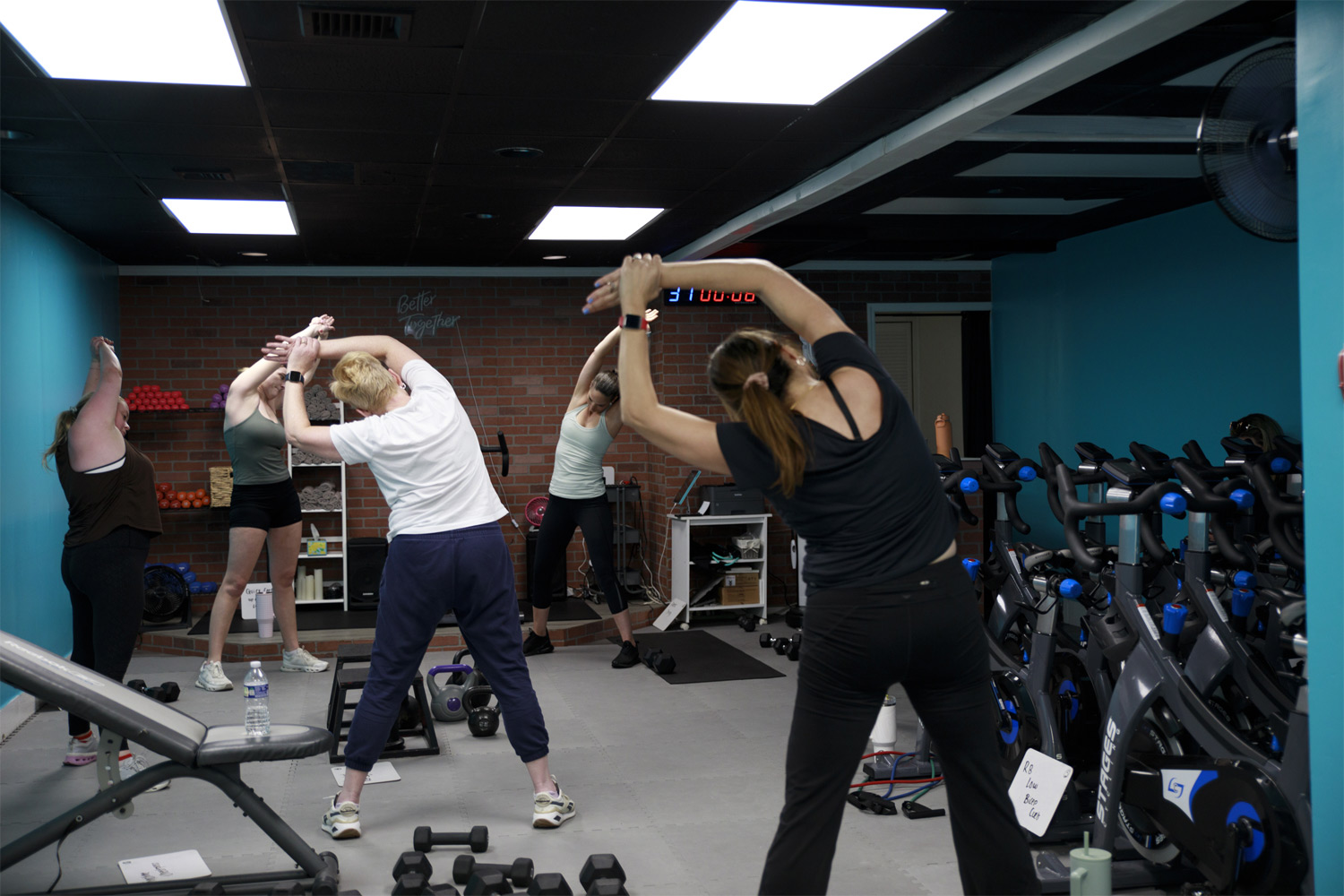
There is a version of a coaching career spent bouncing between facilities that treat instructors as interchangeable and members as churn. There is another version spent somewhere with a clear philosophy, a defined community, and a genuine investment in the people who coach there. The second is harder to find and much better to build inside.
“We are small, which means you are not interchangeable here. Your class is your class, your members know you, and you have real say in what we build. I have been doing this for over ten years and I still teach, so I am on the floor with you rather than in an office.”
— Hallie
Pure Energie is growing, and the coaches who join now will shape what it becomes. For a coach who wants to develop real expertise working with women through this stage of life, that combination of a strong point of view and room to grow is rare.
The philosophy is clear, the community is real, and the studio is hiring coaches who understand that learning someone’s name is not a soft skill. For the right coach, that is not just a job opening. It is a description of the work they have been wanting to do all along.
Pure Energie is located at 16 Old Ashton Road, Building 7, Philadelphia, PA 19152. Coaches and instructors interested in joining the team can reach the studio at (267) 257-2115.
FitHire — Browse Club and Studio Roles Built Around Community
The studios worth building a career at are the ones with a clear philosophy and a real community, the ones that invest in their coaches as much as their members. FitHire by Coach360 connects instructors and coaches with facilities like Pure Energie that are hiring for warmth, skill, and a genuine commitment to the people they serve.
Related: The Coaching Skill Nobody Certifies For and Every Client Notices Immediately
Frequently Asked Questions
What is Pure Energie?
Pure Energie is a women’s-only group fitness studio in Northeast Philadelphia built around the idea that belonging, not workout intensity, is what keeps members coming back. The studio’s philosophy, summed up in the phrase “Better Together” on its wall, centers on coaches learning members’ names, noticing when someone is missing, and making the room feel like somewhere a woman belongs. Pure Energie is located at 16 Old Ashton Road, Building 7, Philadelphia, PA 19152.
Is Pure Energie hiring coaches and instructors?
Yes. Pure Energie is currently hiring instructors and coaches. The studio is looking for professionals whose strongest work happens in connection with members, who learn names quickly, and who notice when someone has been absent. Coaches interested in a studio built around community and a predominantly women-centered membership can contact Pure Energie directly at (267) 257-2115 or explore similar roles through FitHire by Coach360.
Who does Pure Energie serve?
Pure Energie’s membership skews toward women managing a job, a family, and the physical changes of midlife, many of whom have had discouraging experiences at other gyms. The studio’s culture emphasizes being noticed over being corrected. New members can start with seven days unlimited for twenty-nine dollars, with a longer three-week option available for anyone who wants more time to settle in before committing to membership.
What kind of coach thrives at a studio like Pure Energie?
Coaches who thrive at Pure Energie tend to be the ones whose strongest work happens in connection with members rather than in maximizing workout intensity. The studio’s founder hires primarily for whether a coach learns names, greets people individually, and notices when someone has been away, treating certifications as the baseline rather than the differentiator. For a coach who wants to build real expertise coaching midlife women toward sustainable strength, Pure Energie offers a well-aligned place to build a career.
Jessica H. Maurer covers Club & Studio for Coach360News.
About Jessica H. Maurer
Jessica is a recognized fitness business consultant and strategist focusing on transforming businesses from overwhelmed to organized. Her international presentations, workshops, certifications, and consultations underscore her commitment to helping fitness professionals and businesses realize their full potential. When Jessica takes the stage, she’s sharing fresh ideas and inspiration that spark positive change. Jessica’s international presentations and consultations are about growth, career transformation, overall wellness, and making fitness a joyful journey. Her expertise spans education, program and instructor development, and brand evolution, making her a key player in elevating the industry. Jessica also played a pivotal role in developing the Mental Well-being Association’s certification for Fitness Professionals., always striving to bring a holistic approach to wellness that’s as uplifting as it is effective.
Jessica has presented at prestigious events like IDEA World, Fitnessfest ACSM Health & Fitness Summit, SCW Mania, AsiaFit, and more. She has worked with brands such as FIT4MOM, SFR, BOSU, Lebert Fitness, Savvier Fitness, SCW Fitness, FitSteps, canfitpro, IDEA, and VIBES music. She also has written content for the IDEA Fitness Journal, canfitpro Magazine, Mental Well-being Association, FIT4MOM, Motherly, and more.
Next Page »

Subscribe to our Newsletter
Powering the Business of Health, Fitness, and Wellness Coaching