


Ask a seasoned UX designer what makes a great product, and they won’t list features. They’ll talk about friction, flow, and feedback loops. The same applies to gyms, only most haven’t realised it yet.
The gym floor is a tangible user experience. From the moment someone walks in, they’re in an interface: access cards, locker room layout, wayfinding signage, and the unspoken rules of the free weights area. Done right, each step feels seamless. Done poorly, it burns energy that should go to the workout.
The Opportunity Gap
Big chains have focused on expansion, rather than user experience. But the real leverage is in client retention, referrals, and engagement. All three hinge on how members feel as they move through the space.
It is due to this that some independent clubs pull far ahead despite having smaller footprints. They treat the floor like a live environment, constantly iterating how people flow between stations, how trainers interact with guests, and how lighting, scent, and acoustics reinforce zone transitions.
That’s where most operators miss: they think UX lives in the app or on the website. But the real gains are on the floor.
Borrowing from Tech
Think of wayfinding as onboarding. Think of trainer check-ins as CRM touchpoints. Think of poor lighting and sound bleed as UI bugs. That framework changes everything.
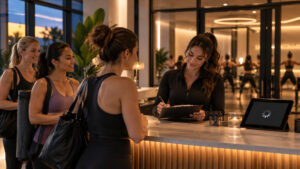
A first-time gymgoer doesn’t want more choice. What they want are fewer unknowns. Clubs that simplify the first five minutes (greeter interaction, locker instructions, map of zones) build momentum fast. That early success compounds into a long-term habit.
It’s the same reason good apps frontload easy wins.
Micro-Moments, Macro Impact
UX in physical space shows up in the quiet gaps. How hard is it to find a clean towel? Can a member finish their workout without needing to stop and ask where something is? Is it clear which spaces are social and which are private?
Every friction point adds dropout risk. That’s the churn cost.
UX-forward clubs conduct audits in the same manner as product teams: observing behaviors, mapping flows, and tracking drop-offs. Do members switch machines mid-set because of spacing? Are new members always crowding one zone while others sit empty? That’s where iteration starts.
Retention Lives in Design
Programs matter. So does talent. But the best programming falls flat if the environment fails. If a class starts late due to poor signage or lost members, NPS drops. If a strength space feels intimidating or chaotic, people default to the treadmill.
Good UX builds psychological safety. That’s what keeps people coming back.
What to Watch
The next generation of clubs will draw inspiration from retail, hospitality, and software industries. Expect:
- Modular zones that adapt to different times of day
- Multisensory UX, not just design, but scent, sound, texture
- Wayfinding tied to usage data (heat maps)
- Staff trained in UX flow, not just customer service
It won’t be about more features. It’ll be about fewer barriers.
Final Thoughts
Great gyms feel intuitive. That’s not an accident. It’s design. And as more members expect their physical spaces to match the polish of digital ones, the winners will be the clubs that treat UX as core infrastructure. True enough, programming still matters, but experience design is the multiplier.
The best gym isn’t the one with the most gear, but the one where people want to stay longer, because every step feels obvious, energising, and friction-free.
About Robert James Rivera
Robert is a full-time freelance writer and editor specializing in the health niche and its ever-expanding sub-niches. As a food and nutrition scientist, he knows where to find the resources necessary to verify health claims.