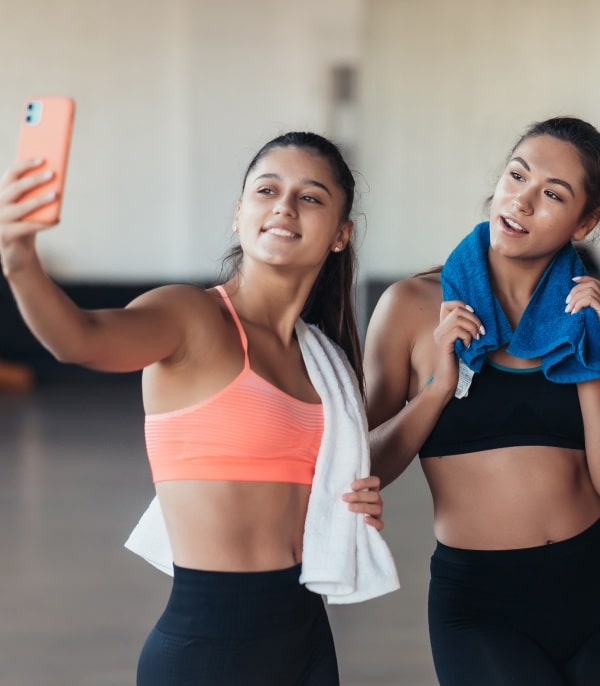



There is an unspoken job requirement in fitness that has nothing to do with certification, continuing education, coaching skill, or years of experience: You are supposed to look like you belong here.
Nobody has to put it in the job description, but fitness professionals learn it anyway.
You learn it when a client’s eyes move over your body before they decide whether they trust your expertise. You learn it when the most visibly “fit” trainer is assumed to know the most. You learn it when photographs are requested for professional opportunities that have little to do with appearance. You learn it through social media, where a coach’s body can become part résumé, part marketing strategy, part evidence that the methods they teach supposedly work. And coaches can learn it from one another.
The pressure may be particularly difficult to name because fitness professionals occupy an unusual position. They are simultaneously expected to challenge harmful body standards and diet culture dogma for their clients while working in a profession that can quietly impose both on them.
Research suggests this pressure is far from imagined. In a study of more than 300 personal trainers and group fitness instructors, approximately 90% perceived body appearance pressure as a societal problem, with clients and colleagues among the most frequently identified sources of their own appearance pressure. Fewer than half were aware of any action their employer had taken to address it.
That matters because this is not simply a conversation about whether fitness professionals sometimes feel insecure about their bodies. It is an occupational conversation about what happens when the body becomes part of the perceived credential.
When Your Body Becomes Your Business Card
There are many professions in which appearance matters to some degree. Fitness adds another layer: the professional’s body can be interpreted as evidence of professional competence.
A client cannot immediately see your knowledge of exercise physiology. They cannot look at you and determine whether you understand behavior change, contraindications, progressive overload, pain science, motivational interviewing, program design, or scope of practice.
But they can see your body. And in an industry that has spent decades using bodies to sell outcomes, appearance can become an easy proxy for expertise. Researchers studying fitness instructors have even described appearance as a form of “bodily capital” within the profession, the idea that a professional’s physique can carry perceived economic or occupational value because it may influence their ability to attract clients.
The problem is not that coaches should stop caring for their own health or enjoying training. Many coaches entered this profession precisely because movement is meaningful to them.
The problem begins when there is a quiet assumption that a coach’s body must continuously prove their professional legitimacy.
A trainer can possess extraordinary coaching skills without having a body that matches the industry’s current visual ideal. A coach can gain weight and remain an exceptional coach. They can age, become injured, experience an illness. Hormones change, medications come onboard, or life circumstances influence what they are able to consistently do.
None of those experiences erase professional knowledge. Yet when the body has become part of the résumé, normal human change can begin to feel professionally dangerous.
Social Media Turned the Coach Into the Advertisement
Fitness professionals have always worked in a body-focused industry. Social media intensified the visibility. The coach is no longer only coaching.
They may also be creating content, building a brand, appearing on camera, posting demonstrations, maintaining a website, marketing programs, pitching partnerships, and competing for attention in feeds dominated by imagery.
In that environment, expertise and appearance can become difficult to separate. A coach can know intellectually that bodies vary tremendously while simultaneously watching certain bodies receive more engagement, attention, praise, and commercial opportunity. That contradiction deserves to be named.
It is difficult to tell clients that health does not have a look while wondering whether your own career requires you to maintain one. And this pressure does not affect only women or only professionals pursuing thinness. Research involving fitness instructors has examined pressures related to leanness, muscularity, and body dissatisfaction, suggesting that the appearance ideal can take different forms across professionals.
The desired body may differ, but the occupational message underneath it can remain remarkably similar:
Look like someone people would want to hire.
The Pressure Can Change How Coaches Treat Their Own Bodies
There is a particular irony in knowing how to coach health-promoting behavior while struggling to extend the same flexibility to yourself. A coach may tell a client that recovery matters while feeling pressure to demonstrate relentless discipline. They may encourage a client to modify training around pain while worrying that doing so themselves will make them appear less capable. They may teach clients that consistency includes adaptation while privately believing that their own professional identity requires them always to be “on.” They may know that bodies naturally change across a lifespan while experiencing their own changes as a threat to credibility. The consequences do not have to look dramatic to matter.
Sometimes the cost is a relationship with movement that becomes less enjoyable and more obligatory. Sometimes it is training in ways that no longer serve the coach’s health. Sometimes it is reluctance to disclose an injury or health challenge because vulnerability feels incompatible with the professional identity they have built. And for some professionals, the accumulated pressure may even raise questions about whether they still belong in the industry.
These concerns extend beyond dissatisfaction with appearance alone. Research examining fitness professionals has identified disordered eating behaviors and other indicators of body-image concern within this population, leading researchers to argue that body appearance pressure should be treated as an occupational health issue within the fitness industry, not simply as an individual problem experienced by a handful of professionals.
The important point is not to look at these experiences and ask why a knowledgeable professional would struggle. Knowledge does not make someone immune to culture. In fact, working inside the culture every day may intensify exposure to it.
Expertise Does Not Protect You From Body Image Pressure
This is one of the assumptions the industry should be especially careful about.
Fitness professionals know more about exercise than the average person. Many have studied nutrition, physiology, anatomy, behavior change, recovery, and health. That knowledge can create an illusion of protection.
Professional education does not necessarily provide immunity. In research examining personal trainers and group fitness instructors, investigators found few differences in body-figure idealization or appearance pressure according to educational level. In other words, knowing more about exercise and health did not necessarily protect fitness professionals from the appearance expectations embedded in the environment where they worked.
That finding makes intuitive sense. Knowing that an unrealistic standard exists does not automatically remove the professional consequences of being evaluated against it. A coach can understand body diversity and still wonder whether a prospective client will trust them. A trainer can understand the importance of recovery and still worry about being judged for changing how they train. An instructor can teach body-neutral language beautifully and still struggle when photographs of themselves are posted publicly.
Professional knowledge and personal vulnerability can coexist. The industry should make more room for that reality.
The Hiring Conversation
There is another part of this conversation that is harder to document and easier to recognize. Hiring.
Most reputable fitness employers are unlikely to state that a coach needs a particular-looking body. But appearance bias does not require a written policy to influence who is perceived as credible, disciplined, marketable, energetic, or “a good fit.” That creates a responsibility for owners and hiring managers as much as it does for coaches.
What does your hiring process actually evaluate? Does your job posting emphasize education, communication, professionalism, empathy, coaching ability, experience, and capacity to develop clients? Or does your marketing imagery quietly communicate what a successful employee is expected to look like? When you interview a trainer, are you evaluating whether they can coach, or whether they visually resemble your idea of a trainer?
The answers matter because culture is not created only through policies. It is also created through what gets rewarded. If one kind of body repeatedly receives visibility, leadership opportunities, prime classes, marketing exposure, or assumptions of competence, everyone else in the organization notices. You do not have to announce the standard for employees to learn it.
“But Clients Expect Their Trainer to Look Fit”
This is where the conversation becomes uncomfortable. Because some clients do. Pretending otherwise does not help.
Fitness is a service profession in which consumers may arrive with assumptions about what competence looks like, just as they arrive with assumptions about what health, strength, discipline, and success look like. The responsibility of the industry is not necessarily to deny that those biases exist. It is to stop reinforcing them.
A coach’s body cannot tell you whether they listen well. It cannot tell you whether they can adapt a program around a client’s needs. It cannot tell you whether they understand progressive programming, communicate effectively, recognize a scope-of-practice boundary, or create an environment in which a client feels safe enough to be honest. It cannot tell you whether their clients remain active years after working with them.
Those are coaching outcomes. Appearance is extraordinarily poor shorthand for all of them.
Coaches Need Somewhere to Be Human
Fitness professionals spend much of their careers being the person who has the answer. Clients bring them frustration, fear, embarrassment, pain, setbacks, changing bodies, aging bodies, injured bodies, and bodies they have been taught not to trust. Coaches are expected to respond with steadiness.
But where does the coach go when the difficult body is their own? That question overlaps with another occupational problem Coach360 has explored: burnout. In The Burnout Blind Spot: Why Fitness Coaches Are the Last to See It Coming, Jessica Maurer examines what happens when a professional identity built around energy and service makes it difficult for coaches to recognize their own depletion.
Body image can create a similar blind spot. When your livelihood is tied to health and fitness, acknowledging that your relationship with your own body, food, exercise, or professional identity has become difficult may feel like admitting you are no longer qualified to do the work. It isn’t. It means the professional is also a person.
Seeking Support Is Not a Scope-of-Practice Failure
Awareness pieces like this require an important boundary. A colleague noticing that another coach appears distressed is not an invitation to diagnose them. A manager should not decide that an employee has an eating disorder. A personal trainer should not attempt to provide treatment to another trainer. And reading this article should not become an exercise in diagnosing yourself.
What it can do is make room to notice when something feels difficult and recognize that professional support is available.
If thoughts or distress related to food, exercise, appearance, or your body are affecting your well-being or daily life, consider speaking with an appropriately qualified healthcare or mental-health professional. The National Alliance for Eating Disorders offers a confidential helpline staffed by licensed therapists who specialize in eating disorders, as well as treatment referrals through its findEDhelp directory.
National Alliance for Eating Disorders: Find Treatment & Support
Support does not require waiting until an experience becomes severe enough to justify asking for it. And needing support does not invalidate someone’s place in this profession.
Maybe Professionalism Was Never Supposed to Have a Body Type
In Strong Is Not the New Skinny: What the Body Positivity Shift Actually Asks of Coaches, Coach360News looked at what happens when the industry replaces one preferred client body with another, and why even positive-sounding ideals can leave the body functioning as the scoreboard.
This conversation asks coaches to turn that same lens toward themselves. If a client’s health cannot be determined by looking at their body, the same principle has to extend to the coach standing beside them. Fitness professionals should be allowed to age in the fitness industry.
Further, they should be allowed to experience illness, to recover from injury, to modify training, to inhabit and honor changing bodies, to have seasons when fitness occupies a different amount of space in their lives, and to ask for help. And to remain credible professionals through all of it.
Perhaps one of the most meaningful cultural changes the fitness industry can make is to stop requiring its professionals to embody the product. The coach is not the product.
The knowledge is. The judgment is. The ability to listen, teach, adapt, connect, program, communicate, motivate, and help another human being build a healthier relationship with movement is. A coach’s body is the body of a person doing that work. It was never supposed to be the credential.
FitHire — Browse Coaching Roles in Client-Centered Facilities
The facilities worth working in hire for coaching ability, communication, and the capacity to develop clients. FitHire by Coach360 connects fitness professionals with operators who evaluate what a coach can do, not what a coach looks like.
Frequently Asked Questions
Do fitness professionals experience body image pressure?
Yes. Research involving personal trainers and group fitness instructors has documented body appearance pressure and body dissatisfaction within the profession, with clients and colleagues identified among sources of perceived pressure. Researchers have argued that fitness organizations should address body appearance pressure as an occupational health concern.
Does being educated about fitness protect coaches from body image concerns?
Not necessarily. Professional knowledge can help coaches understand body image and health, but research suggests education alone does not protect fitness professionals from body appearance pressure.
What should I do if I’m concerned about another fitness professional?
Approach the person with care rather than assumptions or a diagnosis. You can express concern, listen, respect their privacy, and encourage professional support when appropriate. Coaches and managers should remain within their scope rather than attempting to assess or treat an eating disorder or mental-health condition.
Where can a fitness professional find eating-disorder support?
The National Alliance for Eating Disorders provides a confidential helpline staffed by licensed therapists specializing in eating disorders and offers referrals to appropriate levels of care. Its current helpline and referral resources are available through the Alliance’s website.
About Erin Nitschke
Dr. Erin Nitschke, NSCA-CPT, NFPT-CPT, ACE Health Coach, ACE-CPT, Fitness Nutrition Specialist, Therapeutic Exercise Specialist, Pn1, FNMS, and DSWI Master Health Coach, is a seasoned college professor in health and human performance. She is a nationally recognized presenter, industry writer for IDEA, NFPT, Fitness Education Online, and Youate.com, and an active member of the ACE Scientific Advisory Panel. With extensive experience in health and exercise science, Erin specializes in holistic, evidence-based approaches to wellness. Her passion lies in empowering individuals to lead healthier, more vibrant lives through personalized coaching. Erin’s philosophy centers on education, accountability, and sustainable behavior change—guiding clients to achieve long-term success in nutrition, fitness, stress management, and overall well-being. To connect with Dr. Nitschke, email her at erinmd03@gmail.com or on Instagram: @nitschkeerin