
How You Can Incorporate Longevity Into The Fitness Equation
How You Can Incorporate Longevity into the Fitness Equation: Longevity-Based Fitness Coaching
People exercise for various reasons. One can pursue fitness for physical appearance, success, joy, community, or a healthier and longer life, also known as healthy longevity. Generally, clients have one or more motivators to keep improving. Without a doubt, the majority want to live healthier, longer lives. So why not leverage this desire for your coaching business? It’s a win-win situation.
As evidence suggests, exercise promotes longevity, but nobody wants to live longer with health problems or a low quality of life. There is a fine balance between exercise contributing to health and deteriorating it. Because it’s not just about exercising more; it’s also about cultivating personal nuances in nutrition and lifestyle for the best outcomes. So, there is no one training program that fits all. This is where you show up and provide customized, longevity-based fitness planning for clients.
What Is Longevity, Lifespan, and Healthspan?
Let’s first cover the most commonly used longevity-related terms.
- Lifespan is the maximum number of years a person has lived.
- Life expectancy, or average lifespan, is how long a person is expected to live based on age, gender, birthplace, and demographic factors. For example, life expectancy for women is 80.2 years and for men is 74.8 years in the U.S.
- Healthspan refers to the number of years a person lives in good health. For example, a person’s lifespan might be 80 years, but their healthspan could be 65 years.
- Longevity refers to the length of lifespan under ideal conditions. But the term ‘longevity’ doesn’t differentiate between healthy years and unhealthy years of life. So, increased longevity isn’t really a good thing if healthspan doesn’t increase along with it. People not only want to live longer but also aim to live healthier until death. This is why coaching for longevity should focus on improving both life expectancy and healthspan.
How Does Fitness Contribute to Healthy Longevity?
Evidence from 2.6 million participants shows that sports can reduce the risk of dying from any cause by 21% to 24%. The reduction is even greater for deaths caused by heart disease, with a decrease of up to 27%. Exercise promotes healthy longevity by:
- Increasing muscle mass and strength
- Strengthening bones
- Improving metabolism
- Increasing cardiorespiratory fitness
- Improving cognitive and mental health
- Supporting the immune system
In order to promote healthy longevity, you need sustainability. The good news is that this is much easier with personalized fitness coaching.
Longevity-Based Fitness Coaching: Where to Start
What makes the best longevity fitness plan? There should be a fine balance between training load, training diversity, recovery, nutrition, and sleep. This is where you come in as a coach. You will find the sweet spot to improve performance while promoting healthy longevity.
There are genetic contributors to longevity that one cannot change. Luckily, the impact of lifestyle factors such as exercise, nutrition, sleep, and stress is also significant. So, there are many things to consider, but this also brings many opportunities to offer unique coaching to clients.
Here are the things you can incorporate in longevity-based coaching:
- Initial assessment: It’s essential to analyze both goals and lifestyle, including the client’s current training, nutrition, sleep, and habits, as these are the main contributors to longevity. The initial assessment helps identify steps to improve the client’s healthy longevity. In this step, you can also suggest tests, which we’ll cover in a moment.
- Holistic approach to fitness: Nutrition and exercise are crucial—there’s no denying that. But they are not the only contributors to longevity. Other factors, such as mental health, sleep, stress, social connections, and environmental influences, affect health and, consequently, longevity. As a coach, having a holistic approach allows you to step back and see the gaps, so you can offer unique help that bridges those gaps.
- Tests and tools: You need personal data to create a longevity-promoting training plan. Tests and tools can help you identify unideal conditions or health problems that hinder health, longevity, and performance. You can find various tests and tools to collect the data you need. Are you trying to understand why a client is feeling fatigued all the time? Offer an at-home sport performance test or analyze the data from their fitness tracker. These can provide data on the client’s sleep, cardiac, metabolic, and respiratory-related metrics. Do you want to see if the training plan improves the client’s biological age? You can suggest a biological age test that shows the rate of aging, so you can objectively see whether the interventions benefit the client. In this case, choosing tests that come with expert reports can be a better choice since evaluating them can require expertise.
- Diversity of Training: Training for healthy longevity and peak performance overlap, but they can also differ. Healthy longevity requires not only a healthy skeletal system but also well-functioning metabolic, cardiovascular, respiratory, cognitive, and reproductive systems. Therefore, it is important to create programs that support all of these systems. This can be achieved through a personalized program that targets aerobic capacity, strength, balance, mobility, functional exercises, agility, and so on.
- Interventions: Besides training, many other science-based longevity interventions can enhance your coaching. You can incorporate various longevity-promoting methods into your practice, including longevity supplements, red light therapy, and cold plunges.
- Teamwork: Fitness is just one contributor to longevity; nutrition, sleep, and stress are important too. Focus on the importance of all contributors. You can collaborate with other professionals since no one knows everything very deeply. This ensures your clients receive the best support in all areas. Let’s say you think that your client’s nutrition needs extra attention. You can refer them to a dietitian who is familiar with your field and understands their needs. This also increases your client’s trust since you’re helping them, even if it is not directly in your interest.
Final Thoughts
Longevity is appealing to every age. We all want to live a healthier, functional, and quality life. With booming longevity awareness and industry growth, this is the time to incorporate longevity into the fitness equation. As a coach, you have the knowledge to guide clients in the best longevity fitness practices. So, what are you waiting for? Start creating your longevity-based fitness groups with the Marketplace by Coach360 today! The Marketplace is for you coaches too: find jobs within studios and access the resource hub for continuing education. With the Marketplace, you can provide premium coaching to your clients and excel in your career on the same platform!
- What do the terms life expectancy, lifespan, longevity and health span mean? | Max Planck Institute for Biology of Ageing
- Health Benefits of Different Sports: a Systematic Review and Meta-Analysis of Longitudinal and Intervention Studies Including 2.6 Million Adult Participants
- Exercise Sustains the Hallmarks of Health
- FastStats – Life Expectancy
- Training for Longevity: The Reverse J-Curve for Exercise
- Does Physical Activity Increase Life Expectancy? A Review of the Literature
- Molecular Mechanisms of Exercise and Healthspan
- Sport and Longevity: An Observational Study of International Athletes
Creating A Safe Space For Clients With Disordered Eating
Creating a Safe Space for Clients with Disordered Eating
As you know, there is no excellent performance without proper nutrition. But the challenging aspect of nutrition is that there is no one-size-fits-all approach, and neither less nor more necessarily equals better. There is a fine line between following a diet to fuel performance and practicing restrictive eating behaviors in hopes of achieving fitness goals. When that line is crossed, there is a risk of eating disorders, decreased performance, and health conditions.
What Is Disordered Eating
Dieting culture is widespread, but it may intensify even more if your clients have goals focused on appearance. Disordered eating is a term used to describe eating behaviors that restrict foods, lead to under- or overeating, and cause physical discomfort, negative emotions, or a lack of control over eating.
Although disordered eating does not indicate eating disorders, it is considered a risk factor. Many athletes unfortunately self-report disordered eating. This can reflect the fact that your clients may carry concerns about weight, body image, and eating.
How You Can Help
Most importantly, mental health requires professional attention. But as a coach, you observe clients’ behaviors around nutrition, fitness, and performance more than others do. You’re the one they speak to about their goals related to appearance, fitness, performance, and other factors influencing these, including nutrition, dieting, and eating behaviors. Therefore, you can have a significant impact by:
- Observing clients’ behavior: Being observant of your client can provide psychological, behavioral, or physical clues about their approach to eating and dieting. But this isn’t about diagnosing; it’s more about recognizing these signs so you can educate them, personalize their training, or guide them to professional help if needed.
Some clues may include, but are not limited to, critical thoughts about body weight, size, or image; fear of gaining weight; restrictive eating or dieting; all-or-nothing behavior around food; excessive exercising and monitoring; and declines in physical health, such as dizziness, fatigue, weakness, or loss of the menstrual cycle. - Educating: Because nutrition greatly impacts fitness and performance, your client might think that eating much less will result in more weight loss, or that eating much more will lead to greater strength and power. From the start, you can assess their beliefs and educate them about healthy ways to fuel for performance, then provide frequent reminders when needed. It’s about advocating for personalized nutrition instead of restrictive and popular diets.
- Promoting sustainability over fast results: Strict approaches or promises around fast results can encourage all-or-nothing behavior and excessive habits. While discipline is important, adapting a program despite life’s challenges requires flexibility and adaptability. You can be an advocate for sustainability instead of an excessive approach, reminding clients that achieving fitness while maintaining health is a long-term journey. This approach can help clients feel supported without sacrificing their well-being.
- Representing progress: Many athletes strive to be the best version of themselves. They’re disciplined, competitive, and committed to their goals. Sometimes they may feel like they don’t progress at all, while in fact, they have come a long way. In these cases, you can present them facts such as the results of performance tests or any data around their fitness and performance showing they are actually making progress. This can help them put the work they’ve done into perspective and keep progressing with proper nutrition and training without going to extremes that may decline their health.
- Guiding for best nutrition practices: Not all diets or nutrition programs with limitations worsen athlete health and performance. Many science-based approaches exist among popular and unsolicited nutrition advice. Sometimes, strict diets are necessary due to a client’s health conditions. If clients request a specific diet and are serious about trying it, you can guide them to professionals you believe could help. Since this is teamwork, staying in contact with other professionals can help you personalize clients’ fitness journeys for the best outcomes.
Final Thoughts
Disordered eating and eating disorders are detrimental to both health and performance. Some clients may require specialized help from healthcare professionals, but this does not mean you can’t help if you see your clients challenged by their beliefs around nutrition and eating patterns. Acknowledging the psychological aspects of restrictive dieting and its manifestations in physical health and performance can enhance your coaching. It allows you to recognize patterns in your clients and guide them toward best practices for performance, physical health, and mental well-being.
Resources:
- A clinical interview study of identification of eating disorder symptoms and diagnoses in elite athletes
- A systematic review, meta-analysis, and meta-regression of the prevalence of self-reported disordered eating and associated factors among athletes worldwide
- Athletes and Eating Disorders: A Time of High Pressure and Performance | ANAD
- Popular Dietary Trends’ Impact on Athletic Performance: A Critical Analysis Review
- Flexible vs. rigid dieting in resistance-trained individuals seeking to optimize their physiques: A randomized controlled trial
- Eating Disorders, Physical Fitness and Sport Performance: A Systematic Review
- Towards a Sustainable Nutrition Paradigm in Physique Sport: A Narrative Review
Wearables Beyond Fitness Trackers: Smart Apparel Reveals The True Effort Of A Client
Have you ever wondered why everyone, including non-active people, uses a smartwatch? Because even just the idea of personalization is appealing to us. Many people use a smartwatch only to see their heart rate, even if they don’t really use the data. Just looking and seeing a number delivers it. But is this enough for athletes and sports enthusiasts? Are there any better or more comprehensive technologies that give more data? Yes, many. One of them is smart clothing, also known as smart textiles.
Smartwatches measure at least heart rate, calories burned, and sleep. Fitness trackers provide a bit more data, such as blood oxygen saturation, respiratory rate, and stress. Both are really helpful, and many people are already using them. So, you should definitely keep an eye on that useful data, but don’t stop there.
Wearables are going wild: their market size is 178 billion in 2024. A wide range of wearables is available, from smart contact lenses to smart jewelry and textiles. Smart clothing provides extensive real-time data in a very comfortable way. This means you can see clients’ biometrics at any given moment they’re wearing the clothing.
What is Smart Clothing and How It’s Helpful to Clients
Smart clothing consists of garments with embedded sensors. They provide extensive real-time data without the need for extra gadgets. The data you can get from these clothes includes but is not limited to:
- Cardiac: Sensors measure cardiac data, including ECG, heart rate, and heart rate variability. They provide information on heart rate zones, maximum heart rate, and resting heart rate. All this data is highly valuable, offering insights into a client’s recovery, effort, load, and fatigue. ECG, or electrocardiogram, records the electrical activity of the heart. Fitness trackers also measure heart rate, but smart clothing’s ECG is more accurate than the heart rate measurements of most optical sensor-based fitness trackers.
- Respiratory: Sensors can measure breathing rate, minute ventilation, and VO2max (maximal oxygen consumption). These help to understand a client’s aerobic capacity and respiratory efficiency.
- Body movement and temperature: Sensors track body temperature, posture, muscle activity, steps, cadence, and location.
Smart clothing can measure all this data at the cost of most high-end fitness trackers. Imagine having this much biometric data about a client. You can customize their training and monitor its effects on another level with only one tool.
Smart Clothing on the Market
Athos has created a smart T-shirt with 14 sensors. These sensors track the activity and load of upper body muscles, including pecs, biceps, triceps, deltoids, lats, and traps, separately on both sides. It also measures cardiac and respiratory activity, as well as calorie expenditure. When a client puts on an Athos T-shirt, you can see how much each muscle works during training through their app. As a coach, you have access to the Training Center, where you can view a client’s muscle performance data. Athos claims this technology can enhance performance and reduce injury.
Hexoskin and Astroskin provide most of the cardiac and respiratory data mentioned above. They also measure step count, cadence, stride, activity level, burned calories, and sleep quality. Hexoskin has more than 36 hours of battery life and 100 days of recording.
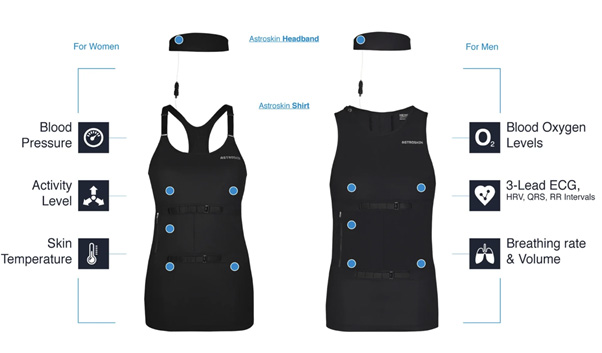
Image: Astroskin | Hexoskin
Zephyr offers a chest-worn strap that is similar to a heart rate monitor. This device measures heart rate and more than 20 other biometrics. These include cardiac activity, respiration, estimated core body temperature, training loads, intensity, and location, such as speed, distance, and elevation.
Sensoria offers a smart T-shirt, sports bra, and socks that measure data related to running. They track speed, pace, cadence, foot landing, altitude, and distance. Spotting poor form has never been easier.
These are a number of companies that currently sell smart textiles. Many more are in development to measure extensive data without invasive methods. For example, current blood glucose monitors are still invasive (the sensors contain small needles), but new research is focusing on glucose monitoring with smart clothing. Can you imagine how this could improve the health and sports performance of many clients with chronic diseases?
TracKnee is another product that is in development. It is designed to monitor knee health. This can be beneficial for the rehabilitation process of many athletes with knee injuries.
New technologies keep coming. Now more than ever, it’s important for coaches to stay up to date with wearable technology. These tools, along with your guidance, help clients reach their optimal health, sports performance, and recovery.
Final Thoughts
Although smart textiles seem to be expensive, they offer great value. Coaches can access useful data that even high-end fitness trackers can’t provide. All this data is there for you to use. You can evaluate a client’s fatigue, readiness, training volume, fitness improvements, and calorie expenditure. This allows you to make personalized decisions for clients’ optimal training intensity and recovery which is crucial to reaching the best sports performance on an individual basis.
Sources:
- A Systematic Review of Smart Clothing in Sports: possible Applications to Extreme Sports
- Review on Smart Electro-Clothing Systems (SeCSs)
- Textile Chemical Sensors Based on Conductive Polymers for the Analysis of Sweat
- Effects of smart garments on the well-being of athletes: a scoping review protocol
- Wearable Technology Market Size to Reach USD 635.82 Billion by 2034
- Effects of smart garments on the well-being of athletes: a scoping review protocol – PMC
- Electronic textiles: New age of wearable technology for healthcare and fitness solutions – PMC
- Smart Textiles and Sensorized Garments for Physiological Monitoring: A Review of Available Solutions and Techniques – PMC
- Smart Shirts for Monitoring Physiological Parameters: Scoping Review – PMC
How To Use At-Home Tests For Clients’ Success
You’re unsure about what’s going on with that one client. Whatever method you try that “works” doesn’t seem to help them, or they only make limited progress. There could be something missing, but you can’t change what you don’t know. Luckily, you just need to look more closely at what’s going on inside their body.
The human body is all about data—our blood, urine, and body fluids reveal the state of health, fitness, and wellness. Data and the facts are a superpower that can catalyze the client’s progression. That’s why many companies bring at-home blood tests to the athlete’s doorstep. They offer a huge variety of tests to measure health and fitness related biomarkers.
By providing or suggesting these tests, you can gain a better understanding of where your client starts, increase efficacy, and drive results. Remember, personalization is what we seek. Now more than ever, we are aware that we are all unique. We need customized services that work best for us. Coaches who have a holistic approach to health and fitness will be the ones who understand clients’ needs and advance their method through personalization.
What Are Fitness and Performance-Based Blood Tests
Many companies that offer at-home tests to measure sports performance, fitness, and health. The process is very easy. Clients are provided with a kit that includes a finger-prick test. They collect the blood and send it to the laboratory. Some companies even offer at-home visits by a nurse or visits to a clinic for an additional cost. The results come in as little as 2-3 days. The great thing is these tests often come with a report that highlights what is missing in the client’s health, nutrition, and lifestyle. Some even offer an action plan to guide the client through steps to reach optimal health and performance.
You can use these tests:
- Before working with the client: Imagine a client who has gone through many programs but hasn’t seen any results. Now, they are turning to you for a change as their coach. You’ll need data to help them. These at-home tests will show you the client’s status before starting the program. You’ll know where to focus for the best progress and set realistic goals for their fitness journey.
- During the process: Testing at intervals helps you measure progress and change methods if needed. You can also take extra tests during training. These tests include glucose, lactate, ketone, and sweat tests.They can further help clients with intense training programs and specific nutrition plans.
- At the end: End results are a great way to showcase the success a client has made and plan further progress.
What Is on the Market Right Now
Many companies offer at-home tests. Some provide tests designed to specifically measure performance, fitness, and health.
Available in the USA
Vitality has very detailed tests, including 85 to 129 biomarkers (standard vs. elite package). In the app, you can see all the results, what they mean, and what to do for training, sleep, nutrition, and supplements to reach optimal values. It even provides 3 to 6 months of personalized programming.
Available in the USA and Canada
Inside Tracker does not offer specific sports performance testing. However, it provides extensive tests measuring biological age, sleep, inflammation, endurance, heart health, metabolism, hormones, and recovery-related biomarkers. So, it gives a full picture of performance and health, too.
Based on the results, it gives personalized advice on nutrition, supplement, lifestyle, and an action plan. Importantly, it has a coach dashboard that allows you to see client’s results. It also offers a subscription model with annual testing, which can be more suitable for checking progress every year.
Available in the UK
Edge is a sports specialist blood testing service. It even provides packages based on sports types, such as weightlifting, cycling, running, triathlon, and CrossFit. They also offer tests that measure hormones and evaluate conditions, such as relative energy deficiency in sport (RED-S).
Thriva supplies sports performance blood tests. It offers options for one-time tests or regular testing at 3-month or 6-month intervals. This is more suitable if you prefer frequent monitoring of progress. Regular testing can benefit clients who have critical levels for multiple biomarkers because you can see if nutrition, supplements, or exercise interventions make a difference. If not, you can change direction without losing any time.
In terms of at-home tests, you can go above and beyond, from DNA testing to microbiome testing. You have the creative power to personalize your services to offer the best coaching possible. Get the help of blood tests without having to spend energy finding a lab or booking appointments; the companies do all this for clients.
What to Look For When Choosing The Tests
Not all at-home tests are made equally. Checking a few things can help you find the best tests for your clients’ needs:
- Accredited lab testing: You can check the company pages to see if they work with accredited laboratories. This ensures the quality and accuracy of the tests. You can look for CAP accreditation, CLIA and ISO certification for the USA, and you can look for UKAS accreditation and CE marking for the UK.
- Tests personalization: Some of them offer packages while still allowing you to customize them, so you can add or remove tests based on your clients’ needs.
- Cost: You can lower costs by choosing a subscription model or multiple test packages. It will be more affordable for clients, and they will receive regular testing and assessment.
Final Thoughts
Test, personalize, and achieve! The fitness industry is all about personalization now. Generalizations have become outdated and are less effective. Although tests may initially add to costs, they ultimately lower expenses by reducing unnecessary interventions. Your client won’t use unnecessary supplements. They also decrease the risk of facing health issues, such as constant fatigue and injuries that can be prevented. As a result, at-home tests can help you make the process smoother and more efficient over time.
Tools now have great leverage for giving personalized data and programs; however, you, as a coach, have the expertise to guide your client. Increase your impact by using these tools to take your services to another level.
Sources:
- https://www.ncbi.nlm.nih.gov/pmc/articles/PMC6901403/
- https://www.ncbi.nlm.nih.gov/pmc/articles/PMC10197055/

Subscribe to our Newsletter
Powering the Business of Health, Fitness, and Wellness Coaching