
All Categories
All Categories
Resilience training was not on my radar the day a client stopped mid-sled push, hands on knees, head down. “I don’t think I’ve got this today.” He wasn’t injured. His numbers said he could handle the session. Strength was there. Conditioning was improving. Something else showed up in that moment. That signal told me more about his actual training needs than any metric I had logged.
Instead of pushing him through it, I asked one question. “What part of this feels hard right now?” He paused, took a breath, and said, “It just feels like a lot.” Not heavy. Not painful. Just overwhelming.
Instead of chasing a breakthrough, we slowed it down — one interval at a time, controlled pace — and finished. Not perfectly. But with purpose. That was when it clicked. This wasn’t about fitness. It was about resilience training.
In most programs, coaches track everything measurable: load, volume, heart rate, pace, rest intervals. We quantify output with precision. Yet one variable influences every session and rarely gets programmed for. It is not on any performance dashboard.
Resilience training addresses a client’s ability to stay with it when things get hard — continuing when effort climbs and energy dips, keeping steady under fatigue, not just when conditions are ideal. It is not motivation, willpower, or mental toughness by another name. It is a trainable skill with a progression model coaches can design, sequence, and measure.
The training variable nobody programs for is the one that decides retention — whether a client keeps showing up after the first hard session, or quietly disappears by month two.
But resilience doesn’t appear at the start of a session. It shows up in the back half of a set — during the second round, at the moment a client decides whether to keep going or check out.
This is visible in HYROX-style training, where strength and endurance blend under sustained fatigue. The movements aren’t always the limiting factor. The ability to keep running them when the system is under stress — that’s resilience training in action. It’s not motivation or hype. It is output under pressure — and it has to be built with intent.
“A big part of resilience training is tying in what happens outside the gym,” says Dr. Darian Parker, Owner of Parker Personal Training, LLC. “Training is a microcosm of what happens outside of the session, so tying in how you modulate effort in specific ways is a powerful connection to effort and pacing of our everyday lives.”
Coaches often treat resilience as a byproduct. Train a client hard enough, the thinking goes, and it will develop on its own. Sometimes that works. However, when resilience isn’t planned, growth becomes uneven — a retention problem waiting to happen.
But resilience can be coached like any other skill. When treated as a skill, it can be progressed and scaled. The mind shift that makes this possible: stop treating resilience as something that just shows up when things get hard. Start treating it as something you design for before the session begins.
But the honest tradeoff worth naming: resilience work requires more coaching attention per session than simply adding load. While you add load, you are watching how clients feel — not just output. That investment pays back in retention and long-term client capacity.
Resilience training doesn’t require rewriting your entire program. Instead, it shows up in how you structure specific moments within sessions. According to the Association for Applied Sport Psychology, mental skills like resilience respond to the same principles that govern physical skill development: focused practice, steady progression, and clear feedback.
Not every session needs to be maximally hard — but some should be. Short intervals work well here. A final set at 75–80% 1RM where the goal is form under fatigue. Or a 40-second timed round where pacing beats speed. Or a sled push at a load that tests both physical output and mental focus.
The key is control. You are not pushing the client too far — you are exposing them to manageable discomfort and teaching them to move through it with purpose.
Resilience develops when clients have to choose between continuing and stopping. Instead of removing that moment, guide it.
“Stay with this pace.” “One more rep with clean form.” “Focus on your breathing and finish the interval.”
These cues anchor attention and shift the client from reacting to managing. That shift is the skill being trained. When it appears, hold the space for it — don’t cut the load.
A key piece of resilience training is how quickly a client can reset between hard efforts. After a tough round, what happens? Do they stay overwhelmed? Or can they regulate and get back to work?
When they do, breathwork, pacing cues, and planned rest become tools. Not just for physical rest, but for building self-control. Teaching a client to recover between efforts — not just physically, but mentally — is resilience training in its most practical form.
In HYROX events, athletes move through repeated cycles of effort and fatigue — running, lifting, pushing, pulling — without extended recovery windows. While the physical demands are clear, what’s less obvious is how much of the race depends on the athlete’s skill of staying composed under stress.
That’s where coaching shifts. It’s not just about preparing the body — it’s about preparing the response. The pacing decisions. The transitions. The skill of staying engaged when the legs are heavy and the next station is 400 meters away. Coaches who know this program not just for results — but for how those results hold when things get hard.
When resilience is trained on purpose, clients start to notice something different. They don’t just get stronger or faster — they become more capable in moments that used to derail them.
With that comes the capacity to recover faster between efforts, stay focused under fatigue, and stop panicking when something feels hard. That carries beyond the gym. Resilience isn’t just a training variable — it’s a life skill. Clients who build it in a structured program begin to apply the same self-control outside the gym. High-pressure moments at work. Everyday decisions.
That transfer is what coaches point to when they describe the deeper impact of their work. That drives long-term retention. When clients feel capable in hard moments, they do not quietly disappear after month two.
Anyone can push a client. That’s not the skill. The skill is knowing how much to push and when. When to introduce discomfort, when to guide the client through it, and when to pull back just enough so they come back stronger.
Resilience training isn’t built by breaking clients down. Instead, it’s built by exposing them to challenges they can navigate successfully. That’s what sticks. That’s what transfers outside the gym. But it doesn’t happen by accident.
You already quantify load, track progress, and measure output. The clients who keep showing up aren’t just physically prepared — they’re resilient. That is a variable you designed for.
FOR COACHES READY TO APPLY
Coaches who specialize in performance can connect with operators who want that depth on FitHire by Coach360. Create your profile and let your approach speak for itself.
How do I know when a client hits a resilience limit versus a physical one?
Watch the pattern between sessions. A physical limit shows up in objective output — pace drops, form breaks. By contrast, a resilience limit shows up in the gap. The data says they can do it. But they won’t attempt it. The client who stops before their body actually needs to — that’s your signal to focus on resilience training.
Can resilience training be built into any program style?
Resilience training fits any format because it lives in how you structure moments — not in the modality you use. A strength client and a hybrid athlete both need decision points and recovery windows. The structured approach — controlled discomfort, a cue at the hard moment, a reset protocol — applies across programming styles.
How do I introduce resilience training to a client who resists hard sessions?
Instead, start with a single focused moment per session. Name it before the set: “This interval will feel hard. The goal is to stay with it for 30 seconds past where you want to stop.” Giving the client a visible target makes the discomfort feel designed. Most resistance to hard sessions is resistance to uncertainty — not to effort.
What does steady progression look like for resilience training?
First, progress the time spent in discomfort — not just the load. Start with a 20-second hard interval with a form requirement. Over four weeks, extend to 35 seconds, then 50. The gains mirror physical periodization: volume before intensity, being steady before duration.
About Erin Nitschke
Dr. Erin Nitschke, NSCA-CPT, NFPT-CPT, ACE Health Coach, ACE-CPT, Fitness Nutrition Specialist, Therapeutic Exercise Specialist, Pn1, FNMS, and DSWI Master Health Coach, is a seasoned college professor in health and human performance. She is a nationally recognized presenter, industry writer for IDEA, NFPT, Fitness Education Online, and Youate.com, and an active member of the ACE Scientific Advisory Panel. With extensive experience in health and exercise science, Erin specializes in holistic, evidence-based approaches to wellness. Her passion lies in empowering individuals to lead healthier, more vibrant lives through personalized coaching. Erin’s philosophy centers on education, accountability, and sustainable behavior change—guiding clients to achieve long-term success in nutrition, fitness, stress management, and overall well-being. To connect with Dr. Nitschke, email her at erinmd03@gmail.com or on Instagram: @nitschkeerin
Bloodwork for coaches has long been useful in theory and hard to act on in practice. When a client does everything right — three sessions a week, meals tracked, sleep improving — the pattern should show results. Yet four months in, recovery still lags. Check-ins don’t explain it. The usual levers have been adjusted. Still, the client is stuck.
For coaches, the barrier was never interest. Most could see the value in lab data. But the reading was the wall. Reading biomarkers and explaining what they mean sits close to a legal line. Yet coaches have no reason to cross it. Vitality Blueprint was built around that specific problem. For coaches worried about scope, the platform draws the line. It does not ask them to read labs. Instead, it reads them, runs the analysis, and gives coaches a protocol to deliver. That takes the legal and ethical risk off the table.
At the center of the platform is the Key Constraint model. The system runs more than 20,000 data runs across 100-plus biomarkers. After that, it scores 13 functional areas. Then it identifies the single biggest bottleneck holding the client back. For a coach whose client is tired and can’t recover, that framing changes the session. The issue may not be effort or discipline. It could be subclinical iron depletion, a poor cortisol-to-DHEA ratio, or a vitamin D level that reads normal but falls short for hard training.
Standard reference ranges are built from broad populations. Being in range can still leave a client flat, under-recovered, and stalled. Instead, Vitality targets performance markers, not disease ranges. That gap is what bloodwork for coaches is designed to close. For most clients, the questions are direct: why do they gas out by 3 PM, why did gains stop, and why isn’t rest producing the recovery their effort should earn.
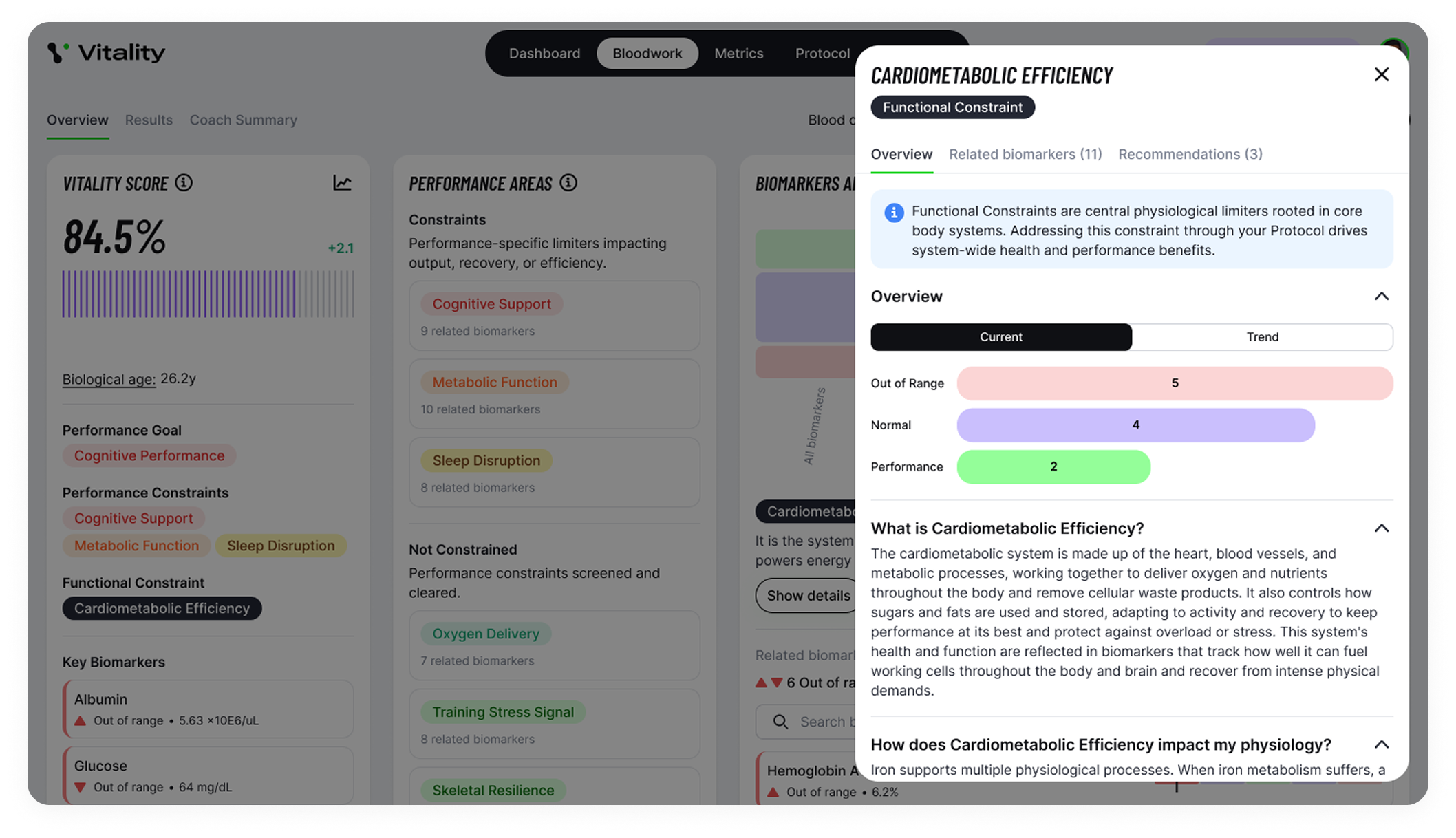
Dan Garner and Dr. Andy Galpin built this from environments where a wrong call showed up fast. Garner spent 15 years reading labs in combat sports and pro teams — fields where small errors carry visible performance costs. Galpin runs the Center for Sport Performance at Cal State Fullerton and has worked with NBA, MLB, and Olympic athletes. Neither built this from wellness language. They built it from cases where the bloodwork explained what the training data couldn’t.
For both, the argument is that elite and general physiology are not separate systems. Iron still carries oxygen. Cortisol still shapes sleep. Thyroid, testosterone, inflammation, and gut function still affect energy and recovery — whether the client is preparing for a world title or just trying to stop fading by 3 PM. But what changes is context. An NBA player may be hunting the last two to five percent. A 42-year-old who trains three days a week and fades by 3 PM has bigger, more obvious gaps. For that client, a core protocol produces more visible results in a single 13-week cycle.
The workflow is clean. A coach signs up. The client gets bloodwork drawn at a standard lab. After that, results get uploaded. Analysis returns within seconds. Then the system finds the Key Constraint and builds a 13-week protocol. The coach delivers it. Without the platform, the coach is guessing at the explanation. When using it, they coach around a defined bottleneck.
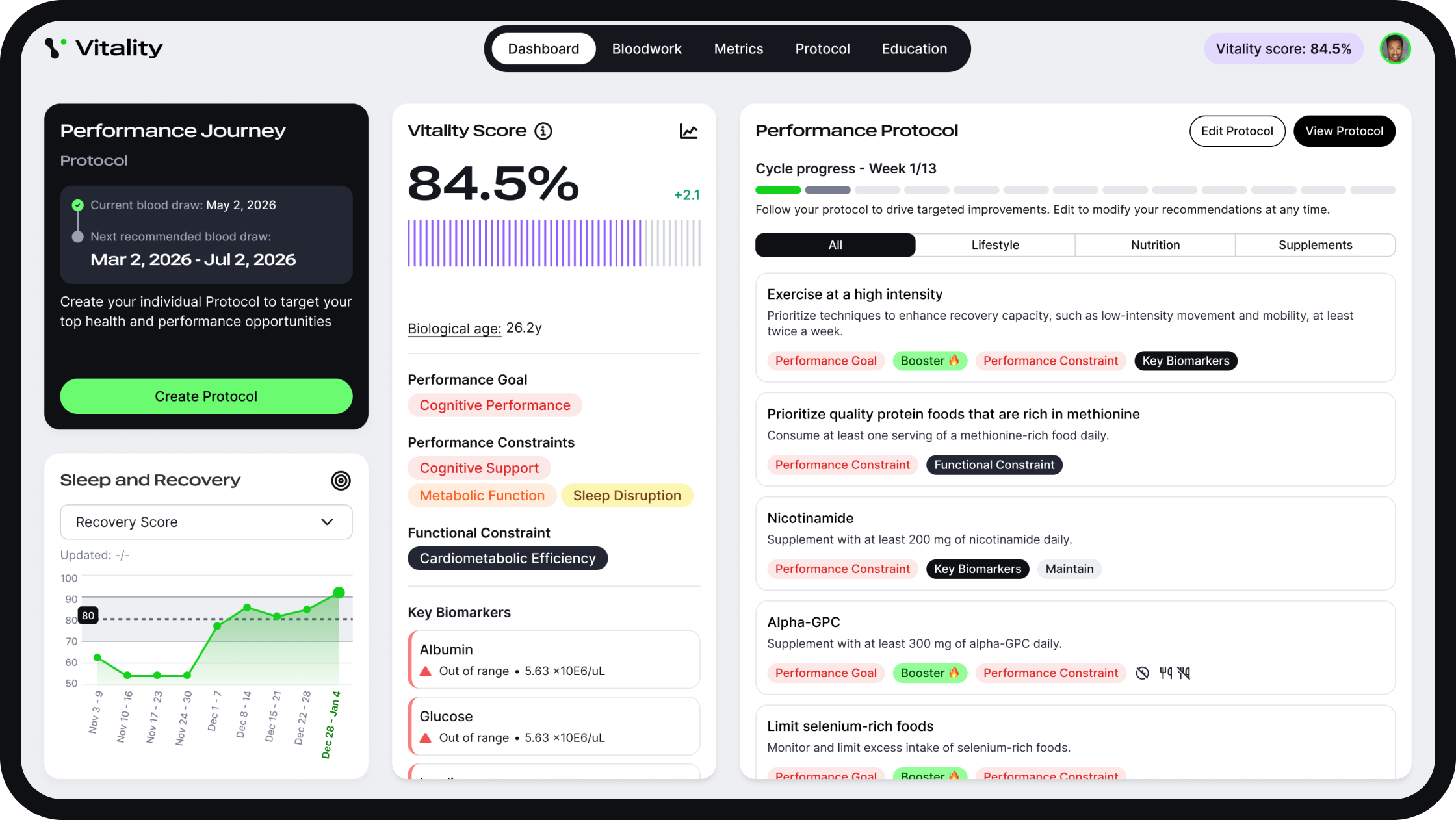
“Instead of guessing, you coach around a defined bottleneck. The issue may not be effort. It could be subclinical iron depletion or a cortisol ratio that’s been off for months.”
DAN GARNER. CO-FOUNDER. VITALITY BLUEPRINT
Coaches can bundle Vitality into a premium tier or offer it as an add-on. In practice, the value conversation shifts. A client is no longer paying for reps, check-ins, or macros. Instead, they pay for a test, a plan, a 13-week cycle, and a retest. That structure gives clients clearer markers to track. It also gives coaches a natural retention system. When the 90-day retest is framed from day one, it does not feel like a late upsell. It feels like part of the process, because it is.
When clients understand what is limiting them and see that constraint shift 13 weeks later, they stay. When they stay, the proof is personal and measurable. That is harder to replicate in a standard model where progress fades after the first obvious gains. It works because it makes the cause visible before the fix is delivered.
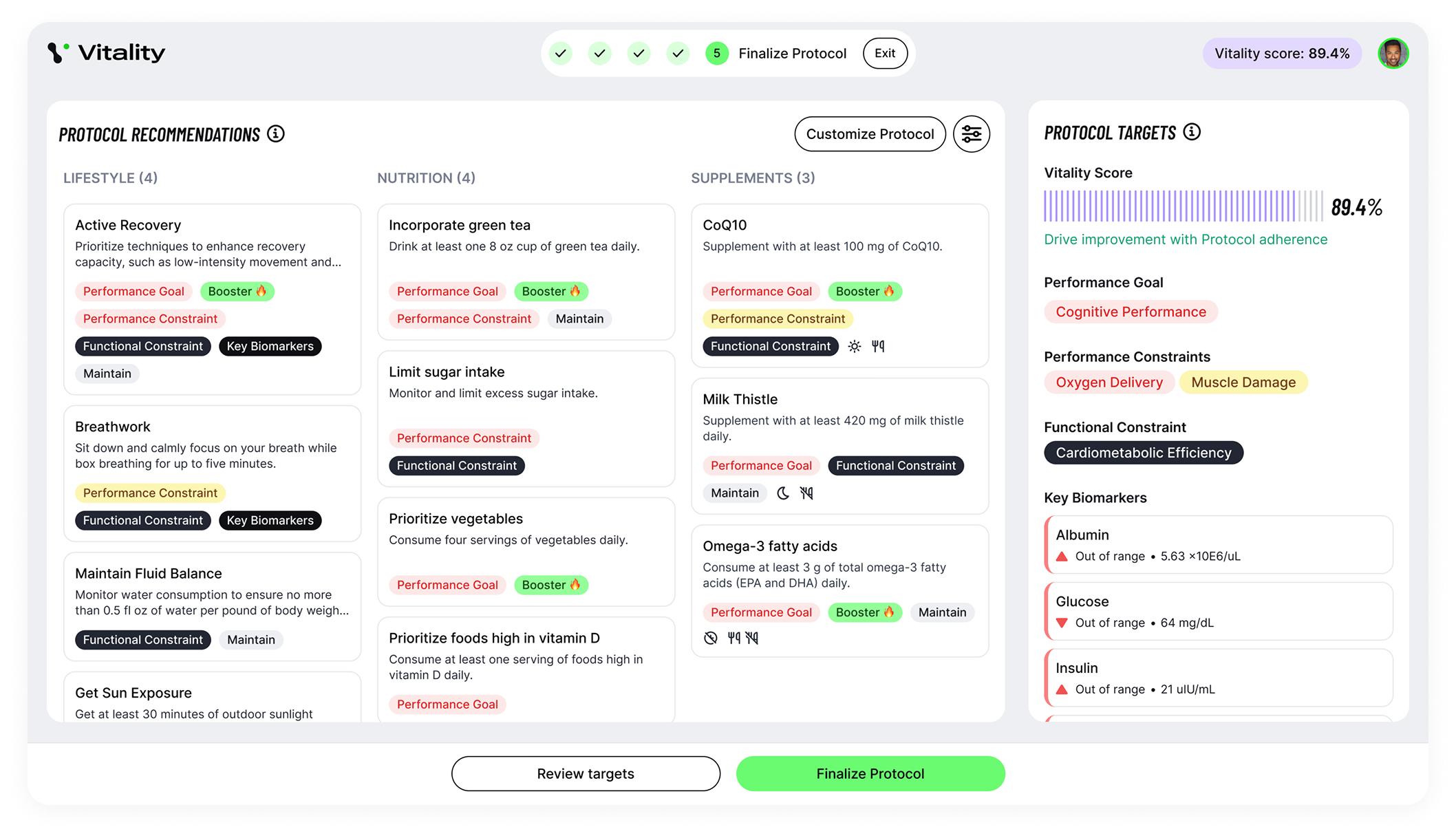
By design, the platform draws the scope boundary. Coaches do not diagnose or treat. Instead, they adapt sessions and adjust load based on what the Key Constraint shows. The system gives coaches one priority constraint and a plan, not a clinical picture. That keeps the work inside coaching. Vitality’s position is straightforward. Performance metrics — muscle mass, aerobic capacity, strength, and energy output — are better daily health guides than a fear of disease. Coaches don’t need to compete with peptide clinics or prescription-driven centers. They stay in performance, recovery, and behavior change — and the bloodwork drives the conversation without a medical credential.
Still, early reviews include coaches and practitioners with strong standing: Tim Jones from Precision Nutrition, Megan Young from the Seattle Sounders, Jill Miller from Tune Up Fitness, and Adam Dupas from Combat Fitness. But the stronger case is simpler. When clients see their own data, they understand the likely cause of their fatigue or stalled recovery. Then they return 13 weeks later with a measurable result. That is the proof point that builds the practice.
Studios adding bloodwork for coaches as a service need practitioners who can connect health data with training and recovery without drifting outside their scope. That is a hiring problem before it is a service problem. Adding it only holds if the coaches on the floor can handle the conversation. For operators building this capability, the selection challenge comes first.
For coaches, the instinct was always there. For most of their careers, they just couldn’t act on it safely. Now they can.
FOR OPERATORS BUILDING THIS CAPABILITY
Find coaches built for data-guided work on FitHire by Coach360. Post your role today.
Does using Vitality Blueprint require a medical or nutrition license?
No. The platform keeps coaches inside their scope. Instead of reading raw lab data, the coach delivers a 13-week protocol based on the system’s output. The boundary between coaching and medicine stays intact by design. Coaches do not make clinical calls. They follow a structured plan built from the analysis.
How does adding bloodwork for coaches change client pricing?
The model shifts the value conversation. Instead of selling reps or check-ins, coaches offer a test, a 13-week plan, and a 90-day retest. That cycle gives clients clear markers and gives coaches a reason to stay engaged past the first phase. Most coaches add it as a premium tier or standalone add-on, priced above their base service.
What kind of bloodwork does a client need?
Clients get bloodwork at a standard lab — the same type used in a routine physical. No specialty clinic is needed. Results get uploaded to the platform and run against more than 100 biomarkers across 13 functional areas. The process works with what most clients can access, not a boutique health panel.
Is Vitality Blueprint built for personal trainers or clinical practitioners?
Personal trainers and performance coaches are the primary users. The platform was designed to make lab data useful without a clinical background. Dan Garner and Dr. Andy Galpin built it from elite performance work, but the model applies across client types. The biomarkers stay the same whether the client is an Olympic athlete or a 42-year-old who trains three days a week.
About Robert James Rivera
Robert is a full-time freelance writer and editor specializing in the health niche and its ever-expanding sub-niches. As a food and nutrition scientist, he knows where to find the resources necessary to verify health claims.


Powering the Business of Health, Fitness, and Wellness Coaching